

This quick and easy recipe uses pollock, a great alternative to cod.
Spring time may be upon us, but that doesn’t mean we have to abandon our beloved comfort food just yet. The weather shows no signs of changing anytime soon so it looks like we’ll have to wait a bit longer to swap our pastries for salads.
We all know that there is nothing more warming than a delicious home cooked fish pie. You can’t beat tucking into creamy mashed potatoes, met with mouthfuls of fresh flavours from the sea. A pie tastes especially appetising when you know the ingredients are all sourced locally and sustainably. The NFFO’s recent #CatchOfTheDay campaign highlighted the importance of eating sustainably sourced seafood and the sheer variety of species available in the UK.
Here Chris Jones, Interim Chef at Chef Jobs UK gives us a fish pie recipe which uses pollock, a sustainable white fish that’s a great alternative to cod.

Recipe
Serves 4
1.1kg skinned pollock fillets
450ml full fat milk
25g fresh dill stalks and fronds
50g butter
50g flour
100ml dry white wine
3tbs baby capers
Zest of 1 unwaxed lemon
3 hard boiled eggs
For the topping:
1.25kg large potatoes, peeled and halved
Salt and pepper
55g butter
1 tsp extra virgin olive oil
25g Parmesan, freshly grated
Method
Place the fish in a large saucepan with the milk and break off the dill stalks and add these. Bring the milk slowly to the boil, allowing to bubble for 1 minute and then remove from the heat.Finally, cover and leave for half an hour.
Meanwhile, make the topping by boiling potatoes in salted water until tender and then draining thoroughly. Mash with the butter, oil and the cheese and season to taste. You should also strain the fish liquor over a bowl and break the fish into large chunks and place in an ovenproof dish.
In another saucepan, melt the butter and add the flour. Stir the contents of the pan for 1-2 mins then add the wine and milk, whisking constantly until smooth and thick. Remove from the heat, add the capers and lemon zest, chop in the dill and season to taste.
Slice the eggs and place over the fish, then tip over the sauce. Top the mixture with mash, smooth the top and then fork up.
Preheat oven to 190⁰c/375⁰F/gas mark 5
Place the fish pie on a baking tray in case of spillage and cook for 1 hour
After an hour has passed, you’ll start to smell the beautiful aroma of your fish pie. Remove the pie from the oven once the topping has just started to turn golden brown and dish up immediately. As this is such a hearty meal, serve with a light vegetable such as fresh garden peas or a light salad tossed with lemon juice to bring out the flavours of the fish. Bon appetit!
We have received the following update from DEFRA:
Overview
Further to the measures applied so far
in 2015 – and following the latest discussions at EU level – the European
Commission will propose monthly vessel catch limits for bass, seasonal closures
on targeting activity for the commercial sector and an increase in the minimum
conservation reference size (MCRS) for bass to 42cm for both recreational and
commercial sectors.
Details
Following the emergency measures this
year, which closed the mid-water trawl spring fishery on spawning aggregations,
and the new 3 fish bag limit for recreational anglers, the European Commission
intend:
- To propose
a second in-year amendment to the fishing opportunities Regulation for
2015 with monthly bass catch limits by fishing gear groups and some specific
area provisions. This proposal could be made in late April – which suggests
new monthly vessel catch limits for bass could be in place as soon as
June.
- In
parallel, to use implementing powers for immediate action to conserve
stocks to propose amendments to the EU Technical Conservation Regulation
(EU 850/98) to: increase the bass MCRS
to 42cm for both recreational and commercial sectors; apply seasonal
closures for targeting activity by commercial fishing gear vessel groups;
and make a mesh size adjustment to 110mm+ for fixed gears to target bass,
in line with the MCRS increase. Timing is uncertain at this stage but
this is likely to be agreed before the end of the year.
- The
Commission are also looking at the potential to ask for advice from the EU
Scientific,
Technical and Economic Committee for Fisheries(STECF) on the elements of the interim bass package, for
example, the monthly catch limits and possible seasonal closures by
fishing gear group, as well as the earlier emergency measures, though the
timing of such advice need not delay implementation of the catch limits
and other provisions.
It is clear that the view of the scientists
in STECF and in the annual ICES assessment will now be pivotal. The new ICES
advice should be available in late May or early June.
The Federation accepts that some remedial measures
are inevitable, although we do not agree that the 80% reduction in fishing
mortality, suggested by an MSY approach, would be deliverable, necessary or appropriate.
We support a balanced package of measures, including all fisheries which impact
the bass stocks, applied in a fair and proportionate way. We reject
opportunistic moves by some in the recreational sector (clothed in conservationist
disguise) to reserve the whole bass fishery for recreational use.
Extending protection measures
for marine habitats is currently the major thrust of marine environmental
policy. The view that bottom trawling is
destroying vast swathes of marine habitat on an annual basis, likened to the
destruction of the tropical rainforests, has long been pushed by ENGO’s to instil
a sense of moral panic in order to bolster campaigns for marine protected areas
(MPAs). Whilst the deforestation analogy
is fundamentally flawed – fishermen will generally return to the same fishing
grounds from year to year – the industry has struggled to comprehensively
refute such claims as it has been unable to account for its true
footprint.
Gear
Modifications as an Alternative to MPAs
The extent to which the seabed
is actually fished is still a subject of research and debate, but whilst the conventional
response has focussed on area closures such as MPAs, little attention has been
paid to gear technology. A gear modifications
workshop held after the Boston Seafood Expo on 19th March, brought
together scientists, industry, NGO’s and policy specialists, to challenge the one-dimensional
approach to the issue, by asking what practical steps can be taken to reduce or
mitigate seabed pressures generated by trawl gears. A series of presentations of work undertaken in
this field demonstrated the huge potential for reducing the seabed contact of
various trawl gear components such as trawl doors, bridles/sweeps and foot
ropes, and hence considerably reducing the overall fishing footprint of those
fisheries.
The conclusion drawn from this
way of thinking about marine habitat conservation is not therefore that more
areas of the seabed need to be protected through spatial closures such as MPAs.
Instead, by recognising and facilitating
efforts to reduce gear seabed contact, both conservation objectives can be met,
whilst fisheries continue to be permitted, resulting in a win-win outcome. As a result, such an approach has been successfully
used as an alternative to area closures for Alaskan fisheries in the Bering Sea
and Gulf of Alaska. In contrast, in
Europe, it has yet to get a hearing in any policy debate.
Practical
Considerations
Whilst hugely promising, the
approach is not without practical challenges.
Many experimental gear trials in the past have failed as they have not
worked effectively with the users of the gears, the skippers, or there has not
been the will to work through the process of adapting experimental designs in
order to get them to work. There is
little point in adopting new gear designs if they are going to significantly impede
catching potential; greater fishing effort is then needed to catch the same
level of catch, undermining the benefits of the modification. Therefore, joint working between gear
technologists, gear manufacturers and industry, and understanding the drivers
and motivations behind the adoption of gear changes or practices is key. Regulators will also need to recognise gear impact mitigation as an acceptable management
response.
Prospects
The Boston event was an early
foray into the possibilities that might offer an appropriate route for our own
fisheries. For conservationists, such an
approach might not provide the level of emotive satisfaction associated with designating
ever greater numbers of MPAs. But it is quite
possible that gear modifications offer a route to marine habitat conservation
that will deliver far more in reality than any MPA will ever achieve. It’s time to think about it.
Landings Obligation
The landing obligation comes into force for demersal species
in January next year. If the member states are going to submit joint
recommendations for regional discard plans, these must be agreed and submitted by
this June at the latest. If they cannot agree, the default is a Commission
regulation and nobody wants that; least of all the Commission.
It is nearly 24 months since an opportunist celebrity chef
and a gung-ho Commissioner, and their
allies, succeeded in persuading the European Parliament and the Council of
Ministers that a landings obligation would be a good idea. But at this stage, a
matter of months away from its implementation, we know next to nothing about
how the new regime will operate.
This is not because of inactivity by any party. The discard
ban for pelagic species naturally took precedence as it had an earlier start date.
But the delay is also because the implementation of the landings obligation in
mixed demersal fisheries is fiendishly difficult.
The landings obligation landings is billed to to auger in the
most significant change to the management rules since the CFP was established.
If this is the case, fishing vessels will need time to adapt. Operators will need
to know the rules under which they will have to operate.
Land all quota
species
The landings obligation itself is simple enough: all quota
species will have to be landed and will count against quota. But fisheries
managers know that in a system of Total Allowable Catches in mixed gear,
multi-species, fisheries, where quota distribution is based on international
and domestic relative stability, and
where selecting out unwanted catch on the seabed is not always possible, this
is a recipe for economic and social disaster. Exemptions, phasing, and quota
flexibilities will all be necessary to make the landings obligation workable.
This however, inevitably makes the regime more complicated.
Regional Discard
Plans
The NFFO has been working with the North Sea and North
Western Waters advisory councils, who have in turn been working with the member
states to design and agree a workable approach.
North Sea
The North Sea AC has taken the view that the least worst, and certainly the simplest
and cleanest way to phase-in the landings obligation would be to start in the
first year with only one species; then learn the lessons, allow the industry
and system managers time to adapt before moving on to the next species. All
vessels operating within a sea area would be required to land the same species.
This is the way that Norway introduced their discard ban, incrementally adding
species and making the necessary adjustments along the way.
This is not what is going to happen. The problem is that under
extreme political pressure the CFP basic regulation fell into the old trap of
being too prescriptive and having insufficient grasp of the realities fishing. This
early mistake has subsequently led to much soul searching between member states,
and within the Commission, about whether it is possible to “break the whitefish
cluster” of cod, haddock, whiting and saithe, to ease in the landings obligation
in its first year by applying the discard ban to only one or two those species;
or similarly, to break the flatfish cluster, with sole and plaice treated differently.
North West Waters
The NWWAC and member states took the view from the outset that
given the diversity of fisheries in its area of jurisdiction, a fisheries
approach to phasing would be required. However, there is no disguising the
difficulty of defining separate fisheries when different rules will apply on
either side of any boundary that is created.
Whilst some member states seem to favour using the gear
categories developed the under the EU Cod Plan, ( TR1, Tr2, BT1, BT2 etc,) others
point to the inherent rigidity in such an approach. The other weakness of an
approach based on gear categories is that its dependence on use of a particular
mesh size range, at exactly the time when vessels might need to change their
mesh size (and other aspects of their fishing operations) to reduce unwanted
catch, is potentially to put an obstacle in the way of vessels’ adaptation to
the landings obligation and to set up the kind of perverse incentives that we
have seen before in the Cod a Plan.
An alternative is to look at what a vessel has caught in the
past in order to allocate it to a particular fishery with particular discard
rules. The trouble with this is obvious: it is backward looking and is
bound to come into friction with any
significant level of change in what has always been a dynamic industry.
A NWWAC drafting group has suggested a radically different approach:
let the fisherman decide, at the start of the year, or season, or even before
the start of each trip, in which of the defined fisheries vessel is
participating (whitefish, nephrops,
hake, flatfish). This would determine the discard rules under which the vessel
is operating, at least for the three years 2016-2018 over which the landings
obligation will be phased in. Linked to a phased approach, this elective approach would limit the
landings obligation to one species in year 1, this approach seems to marry
simplicity with flexibility. The mandatory use of electronic logbooks in all
over-12 metre vessels goes a long way to making such an approach workable.
Again, the signs are that it is highly unlikely that this approach will be used
– but not for any coherent or rational reason but for short term administrative
convenience.
Meetings Meetings
In order to deliver regional
discard plans by the due deadlines, agreed and discussed with the advisory
councils, an intense programme of meetings is under way. Fisheries Directors are
meeting regularly in High Level
meetings to agree broad strategy and principles; officials from the member
states also work in technical
meetings on the design and details of their discard plans. Phasing, definition
of fisheries, quota uplift, high survival exemptions, de minimis exemptions,
minimum conservation reference sizes; these are the issues that the member
states are tussling with. There are significant differences in approach between
the member states. Some take a more purist legalistic approach whilst others
already less focused on legal texts than in designing something that works in
the real world. The pressure is on them, however, to come to a unanimous agreement on the content
of the discard plans.
Sometime in May
Probably sometime in May, the
advisory councils will be asked to comment on the draft discard plans. These will
indicate what species will have to be landed in the first year; they will also indicate
where the member states intend to apply for exemptions on the grounds of the
high survival rate of species when they are returned to the sea; they will also
specify de minimis exemptions, to be
used where there are problems in making the fishery more selective, or where there are disproportionate costs
involved.
Quota Uplift
At that point fishing vessels will
be able to begin to assess the implications of the discard ban in its first
year. But there will still be an important piece of the jigsaw missing: the
quota uplift that will accompany TACs being based on total catches rather than
just landings. That will not be known fully until the December Council,
although pointers will be available when ICES publishes its annual advice in
late May, early June. One of the appealing features of the species approach was
that it would require the addition of entirety of the estimated discards into
each TAC. A fisheries approach, with different vessels operating under
different discard rules means that any quota uplift is likely to be partial and
raise difficult questions over the distribution of the quota uplift. A further
worry is that ICES data on discard rates in the different fisheries can best be
described as patchy. In some fisheries there has been pretty comprehensive
observer cover and the discard estimates are pretty sound; in other fisheries
the assessments depend on something closer to educated guesswork. All of this
could have a profound impact on the level of quota uplift in specific fisheries
and the likelihood of chokes.
High Survival
It makes sense to most people to
return to the sea that part of unwanted catch that has a good chance of
surviving and adding to the biomass of that species. A rational approach to a
landings obligation would have preceded the ban by an extensive period of data collection and analysis.
Knowing which species exhibit high survival, under which conditions, is
critically important to making sensible decisions. The rushed timetable
precludes this and so member states are going to have to make some
political/pragmatic judgements on which survival exemptions to include in their
joint recommendations for discard plans. We think that it makes more sense to
grant exemptions, then remove them if the evidence isn’t their to support them,
than to create onshore infrastructures to deal with unwanted catch, only to
abandon them when the evidence suggests that an exemption is justified. The key
criterion should be whether an exemption increases or decreases overall fishing
mortality of the species concerned.
Steps
Once the discard plans are agreed
by the regional member states, they will be submitted to the Commission. The
Commission’s quality control body, the
Scientific, Technical, Economic Committee for Fisheries, will then be asked
to evaluate the regional discard plans. If considered acceptable they will then
be adopted through a Commission delegated act. The European Parliament will be
invited to express an opinion (but only an opinion).
Only at that stage will vessels
begin to have some idea in broad outline of what lies in store for them in 2016.
One size fits all
The NFFO was amongst the first to argue that one central
reason why the CFP had repeatedly failed to deliver effective management
measures was fundamentally down to its reliance
on top-down, over- centralised, decision making. We argued, persuasively as it
turned out, that the Council of Ministers, and the Commission, were too remote
from the many complex and diverse fisheries under the CFP, to have any hope of
designing management measures that could be implemented effectively. The law of
unintended consequences seemed to be particularly active in fisheries managed
from the centre in Europe. Initially rejected by many as the renationalisation of the CFP by the back
door, the idea of decentralising the
CFP gradually gained currency as the only politically realistic route away from
blunt, one-size-fits-all measures
with an unacceptable failure rate.
Co-decision
In one sense, the Commission’s hand was called, as the
Lisbon Treaty introduced co-decision which meant that the European Parliament would
in future have direct jurisdiction in policy decisions for European fisheries.
In an unguarded moment one Commission official reflected that this meant that
CFP decisions had shifted from 28 people who don’t know what they’re talking
about to 751 people who don’t know what they’re talking about. Under co-decision
a new regulation could be expected to take two years to pass through the
legislative process. Regionalisation was a conscious step away from this type
of cumbersome centralised decision-making, albeit in a heavily circumscribed and
limited way.
Regional Advisory
Councils
The recognition that management decisions within the CFP
were too remote from the people that they affected, breaching all the rules of
good governance, was actually evident in the 2002 reform of the CFP . The
regional advisory councils were introduced as a tentative way of addressing mounting
criticism of the way that the CFP went about its business. Few at the time anticipated
however that fishermen from the different member states could sit down with
each other and thrash out meaningful, well founded, advice; much less that in most cases it would be
possible to agree compromise positions with other stakeholders such as the
environmental NGOs. But in all of the regional advisory councils this has been
the experience, to a greater or lesser degree. It is widely agreed that the
RACs were the most successful aspect of the 2012 reform.
Reform
It was the 2002 reform however, that saw the regionalisation
agenda shift from the advisory directly into the area of policy formulation. The lawyers ensured
that the EU Treaties were respected and that there was no question that member
states would have direct legislative powers; but the intention was that member
states would be given explicit authority to work collaboratively at regional
seas level to produce joint recommendations and that those joint
recommendations would have privileged status as they are fast tracked by the
Commission through delegated act into legislation.
Taking Stock
It is reasonable to ask the question: after two years, how
is regionalisation working?
It would be too glib to say that it’s too early to say. But
it is also true that it will be over time that the effectiveness of regional policy
formulation will be assessed. We should probably not rush to intemperate and
premature judgements. Regionalisation has been a long time coming. It is in its
infancy and we can expect it to take a few tumbles as it take its first baby
steps.
And it hasn’t helped that in its first outing,
regionalisation has been tasked to deliver joint recommendations on the most
far-reaching, most indigestible, piece of European fisheries legislation yet to
emerge: implementation of the EU landings obligation.
What we can say is that member states are working
collaboratively (not to say feverishly) at regional seas level to deliver
regional discard plans by June. Member states with direct fisheries interests
in the North Sea and in North West Waters have been meeting regularly at
fisheries director level and at technical level in an intense programme of
work. They have to make joint recommendations on questions of critical
importance, such as phasing the
introduction of the landings obligation and the exemptions that should apply – or hand the whole matter back to the
Commission, which would then come forward with its own plan by default.
A rational approach to a discard ban would have been to build
up the knowledge base on actual discard rates in the different fisheries, and
to do the science on high survival to
underpin decisions on exemptions – before implementation decisions are made. The basic CFP Regulation however precludes
that and forces a timetable that is bound to lead to casualties. These are the
less-than-optimal conditions in which the member states are working.
Advisory Councils
Under the CFP reform RACs became ACs but despite
regionalisation, their essential
function remains the same: to provide advice. The difference is in who that
advice is delivered to. The regionally cooperating member states rather than
the Commission are the main recipients
of the ACs’ advice on the discard ban. The ACs have been invited to participate in parts of the High Level
(Fisheries Directors) and Technical meetings to explain their respective
positions on phasing, definition of fisheries, high survival and de minimis
exemptions.
But this is not co-management or anything like it. The
decisions made within the joint recommendations may or may not reflect elements
of AC advice. The signs are that to a large extent their advice on the big
ticket items will not be followed.
Member States
It is well to remember how new all this is to member states,
who are used to dealing more or less individually with the Commission; and are now
obliged to forge joint recommendations.
It is possible to see national characteristics as well as different fleet
interests, personalities and politics all at work within the groups. Some
member states insist on focusing on a workable and practical approach, whilst
others argue for the most rigid interpretation of the (deeply ambiguous)
legislation.
Joint Recommendations
We will soon learn the contents of the joint recommendations
for regional discard plans. The signs seem to be that what will emerge will be
a landings obligation that for the demersal fisheries will require vessels to
land one or perhaps two species in the first year. Fisheries will be defined in
relation to area of operation, gear used or target species. There will be some
high survival and de minimis exemptions. Later, we will learn about quota
uplift and quota flexibilities. The ACs will have a brief opportunity to
comment on the joint recommendations before they go to the Commission, and
STECF for evaluation.
Regionalisation.
So, what conclusions can we arrive at? Is regionalisation a
damp squib, or the path to a more rational and effective CFP?
In our judgement, it is both. The jointly agreed discard
plans will not offer the best way to implement the landings obligation; we can
expect many of the characteristic of the old CFP to emerge during their
implementation: Unintended consequences by the bucket load, conflicting,
contradictory rules; confusion; and mistrust can all be expected to be part of
the mix, as well as vessel operators trying their best to comply with the new
and confusing rules and keep their fishing businesses viable.
The fault for all of this
will not primarily lie with regionalisation
or the member states, rather the problem is the same old story. The CFP basic
regulation, and in particular Article 15 is overly-prescriptive and ties member
states’ hands to an unacceptable degree. More than anything else, the content of the discard plans will reflect
the views, not of the member states, or the advisory councils but the “28
people who don’t know what they are talking about and the 751 who know even
less.”
Regionalisation is the first step in decentralising the CFP
and it is more important than ever that it is developed and nurtured. But it is
clear from Article 15, and from the Commission’s bizarre proposal to ban
small-scale drift nets, that the discredited command-and-control way of
thinking has not gone away. Top down is far from dead.
The challenge is not to throw the regionalisation baby out
with the bathwater because the landings obligation is a car crash but to work,
stepwise, towards a form of co-management that provides a solid basis for a
collaborative approach to fisheries management; only that that will relegate top-down decision-making to
history because it isn’t needed. This will take time; but there will be a
proposal for a new technical measures framework later this year and that will provide
a good place to start in making the shift from prescriptive top-down
micromanagement to a more flexible approach that decentralised a real measure
of authority to regional level.
Decentralising the CFP was never going to be a simple or
straightforward process but we have little choice but to work hard to make it
work. We already know that the alternative is far worse.
Accompanied by his journalist wife, Linda, the meal
reflected the diversity of the fishing industry’s produce and fleets which
Austin has fought for over those many years.
As Chairman of the All Party Parliamentary Fisheries
Group, Austin regularly provided a platform within Parliament through which the
fishing industry’s concerns and issues could be raised. A briefing meeting for
the main UK fishing federations immediately prior to the annual fisheries
debate became one of the landmarks in the parliamentary calendar. His bravura
speeches in his own inimitable style, always
expressing the fishing industry’s concerns became one of the high points
of those parliamentary debates.
In a parliamentary landscape not always familiar with the
fishing industry and sometimes prone to irrelevance, Austin’s interventions
always carried weight because he took the trouble to inform himself of the
industry’s views.
The initiative, dubbed #CatchofTheDay, is being launched by the National Federation of Fishermen’s Organisations (NFFO), the body which represents fishermen’s groups, individual fishermen and producer organisations in England, Wales and Northern Ireland.
Running from Monday 16 March until Friday 20 March 2015, the campaign will encourage people to
share photos and videos which either represent their involvement in the industry or celebrate the fantastic variety of sustainable fish now available to UK consumers.
Throughout the week members of the UK fishing industry – including fishermen, retailers and
processors – as well as chefs, restaurateurs and members of the public will be encouraged to share their love of sustainable fish through photos or videos using the hashtag #CatchofTheDay.
For chefs and restaurants it could be an opportunity to showcase their best fish dish, or for
fishermen and producer organisations the chance to show an example of a ‘great British catch’. The Federation is urging people to tweet now with the hashtag #CatchofTheDay in preparation of the week and spread word of the event.
Tony Delahunty, Chairman of the NFFO said: “The idea behind #CatchofTheDay is to give individuals the opportunity to recognise the fishing industry and its contribution to UK life through one
simple tweet. We hope it will be a fun way of getting across a serious message not only about the importance of the industry in providing a healthy, sustainable food source to a growing population, but also its inherent commitment to ensuring its future through sustainable methods.”
Over half (52%) of people in the UK now eat seafood at least once a week and in 2013, 624,000
tonnes of fish were landed in the UK, generating a £718m economic contribution from the industry.
This initiative is being launched as part of the NFFO’s ongoing efforts to raise awareness of the growing variety of sustainable species in UK waters and the important strides which have been made by the industry, particularly in the last 10 years, to improve gear and catch methods to in turn boost stock
levels. According to the latest ICES (International Council for the Exploration of the Sea), there has been a 50% reduction in fishing pressure across all commercial stocks in the North Atlantic since 2000.
To get involved in #CatchofTheDay, tweet your photos with the hashtag during the week 16-20 March. Visit the NFFO website for further information: https://www.nffo.org.uk/
TV chef, food
columnist and Great British Bake Off Winner John Whaite, is backing a Twitter
campaign urging consumers to embrace the breadth and variety of sustainable
fish available over the counter and caught by the UK fishing fleet.
The campaign
dubbed #CatchOfTheDay is being run by the National Federation of Fishermen’s
Organisations (NFFO), the body which represents fishermen’s groups, individual
fishermen and producer organisations in England, Wales and Northern Island, to
champion the diversity of the UK fishing fleet and encourage consumers to be
more adventurous with their choice of fish, trying species outside of the
‘seafood staples’ of cod, haddock and salmon.
The campaign is
calling for the fishing industry, chefs, producers and fish lovers in the UK to
share their ‘Catch Of The Day’ photos on Twitter from 16-20 March with the
hashtag #CatchOfTheDay.
This initiative is
being launched as part of the NFFO’s ongoing efforts to raise awareness of the
growing variety of sustainable species in UK waters and the important strides
which have been made by the industry, particularly in the last 10 years, to
improve gear and catch methods to in turn, boost stock levels. According to the latest ICES (International
Council for the Exploration of the Sea) statistics, there has been a 50%
reduction in fishing pressure across all commercial stocks in the North
Atlantic since 2000.
In 2013, 624,000
tonnes of fish were landed in the UK, generating a £718m economic contribution
from the industry. Over half (52%) of
people in the UK eat seafood at least once a week, though 62% rarely strayed
away from trying alternative species, due to not knowing how to prepare it and
not liking the look of it.
As a result of the
findings, celebrity chef and food columnist John Whaite has worked with the
NFFO to create a series of recipe cards to encourage consumers to consider
cooking with sustainable species of fish, proving they are just as versatile as
the ‘seafood staples’, whilst supporting the work of UK fishermen. Consumers
are then being urged to try John’s recipes and tweet photos of their finished
dishes with the hashtag #CatchOfTheDay.
John said: “There
is a huge variety of fish available from UK waters and it’s such a shame that
people don’t embrace this more. Cooking with different kinds of fish brings
variety to our diets and also introduces us to new tastes and dishes.”
“As an ingredient,
fish is incredibly versatile and there is nearly always a sustainable
alternative to any species. #CatchOfTheDay is all about celebrating the hard
work of the UK fishing industry and celebrating the incredible range of species
available from our waters. I really hope people will be inspired by the recipes
I’ve created and will try some different kinds of fish!”
Tony Delahunty, Chairman of the NFFO said: “The idea behind #CatchofTheDay is to give individuals the opportunity to
recognise the fishing industry and its contribution to UK life through one
simple tweet. We hope it will be a fun way of getting across a serious message
not only about the importance of the industry in providing a healthy,
sustainable food source to a growing population, but also its inherent
commitment to ensuring its future through sustainable methods.”
Show your support and download the
#CatchOfTheDay artwork and let us know you’re on board by tweeting your photos
with the card during the week 16-20 March
Visit the NFFO website for
further information: https://www.nffo.org.uk/
TV chef, food
columnist and Great British Bake Off Winner John Whaite, is backing a Twitter
campaign urging consumers to embrace the breadth and variety of sustainable
fish available over the counter and caught by the UK fishing fleet.
The campaign
dubbed #CatchOfTheDay is being run by the National Federation of Fishermen’s
Organisations (NFFO), the body which represents fishermen’s groups, individual
fishermen and producer organisations in England, Wales and Northern Island, to
champion the diversity of the UK fishing fleet and encourage consumers to be
more adventurous with their choice of fish, trying species outside of the
‘seafood staples’ of cod, haddock and salmon.
The campaign is
calling for the fishing industry, chefs, producers and fish lovers in the UK to
share their ‘Catch Of The Day’ photos on Twitter from 16-20 March with the
hashtag #CatchOfTheDay.
This initiative is
being launched as part of the NFFO’s ongoing efforts to raise awareness of the
growing variety of sustainable species in UK waters and the important strides
which have been made by the industry, particularly in the last 10 years, to
improve gear and catch methods to in turn, boost stock levels. According to the latest ICES (International
Council for the Exploration of the Sea) statistics, there has been a 50%
reduction in fishing pressure across all commercial stocks in the North
Atlantic since 2000.
In 2013, 624,000
tonnes of fish were landed in the UK, generating a £718m economic contribution
from the industry. Over half (52%) of
people in the UK eat seafood at least once a week, though 62% rarely strayed
away from trying alternative species, due to not knowing how to prepare it and
not liking the look of it.
As a result of the
findings, celebrity chef and food columnist John Whaite has worked with the
NFFO to create a series of recipe cards to encourage consumers to consider
cooking with sustainable species of fish, proving they are just as versatile as
the ‘seafood staples’, whilst supporting the work of UK fishermen. Consumers
are then being urged to try John’s recipes and tweet photos of their finished
dishes with the hashtag #CatchOfTheDay.
John said: “There
is a huge variety of fish available from UK waters and it’s such a shame that
people don’t embrace this more. Cooking with different kinds of fish brings
variety to our diets and also introduces us to new tastes and dishes.”
“As an ingredient,
fish is incredibly versatile and there is nearly always a sustainable
alternative to any species. #CatchOfTheDay is all about celebrating the hard
work of the UK fishing industry and celebrating the incredible range of species
available from our waters. I really hope people will be inspired by the recipes
I’ve created and will try some different kinds of fish!”
Tony Delahunty, Chairman of the NFFO said: “The idea behind #CatchofTheDay is to give individuals the opportunity to
recognise the fishing industry and its contribution to UK life through one
simple tweet. We hope it will be a fun way of getting across a serious message
not only about the importance of the industry in providing a healthy,
sustainable food source to a growing population, but also its inherent
commitment to ensuring its future through sustainable methods.”
Show your support and download the
#CatchOfTheDay artwork and let us know you’re on board by tweeting your photos
with the card during the week 16-20 March
Visit the NFFO website for
further information: https://www.nffo.org.uk/
As an island nation, there is a temptation to take the seas around us for granted and forget that those waters provide a vital source of food, employment and contribution to the national economy. Yet the UK fishing industry lands 624,000 tonnes of fish every year, enough for millions of healthy and wholesome meals, and generates an annual income of £718m.

When we’re doing our weekly food shop, the variety of fresh fish sourced from UK waters available over the counter is just the end result of the efforts of the 12,150 British fishermen working
at sea. It is not only evidence of the hard work of the fishermen who caught the fish – but also the producer organisations, suppliers and trade bodies involved in ensuring there is a constant supply of sustainably sourced fish on
our counters.
There is a common misperception that it is just the large trawler boats which supply us with fresh fish. The truth is that the UK has a diverse fishing fleet and smaller boats like my own
are just as important for the supply of this sustainable food source.
As a fisherman myself, I have seen the industry evolve over the past 40 years with consumers and chefs becoming more adventurous with their choices of fish, although the UK’s top three choices are still unsurprisingly cod, haddock and salmon. Over 50% of us eat seafood at least once a week, but perhaps it’s time we were more adventurous with our choice of fish – with species such as Hake and Plaice sourced from UK waters, available in our supermarkets.
Anyone involved in the fishing industry knows that it can be risky and hazardous. Despite all the improvements in safety and technology, the sea is still an extremely dangerous, unpredictable and often not- too- friendly workplace! You only have to watch the rescue helicopter footage of the UK’s youngest fishing boat skipper, 16 year old Jake Bowman-Davies shepherding his crew into a life-raft as his 50ft crabbing boat, the Cresca, sank at night in high seas off the Llyn Peninsula in February, to appreciate that.
For all these reasons, the NFFO is launching a week long Twitter campaign called #CatchOfTheDay, to champion the hard work and diversity of the UK fishing industry. It is also to open consumers’
eyes to the breadth of species of this healthy food choice that is available.
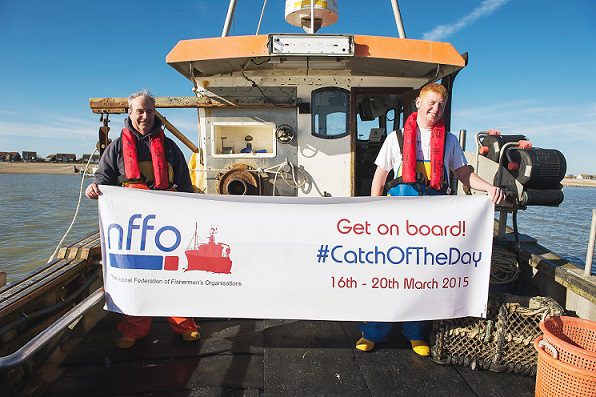
During 16th to 20th March, we are urging fish lovers and members of the UK fishing industry to get involved with the campaign by sharing photos on twitter which represent their involvement in the industry or to celebrate the fantastic variety of sustainable fish now available to UK consumers.
We are asking anyone who has an involvement with the fishing industry – producers, suppliers, chefs, trade bodies, or anyone who just loves a tasty fish dish, to get on board and celebrate the diversity of the industry and give it the recognition it deserves.
We think this is a fun way of getting across a serious message not only about the importance of the industry in providing a healthy, sustainable food source to a growing population, but also its inherent commitment to ensuring its future through sustainable methods.
At a meeting between
the two organisations held this week in Brussels, Europêche pledged to work
with its member organisations to raise awareness of the issue and encourage
fishermen across Europe to get involved in clean up initiatives.
Across Europe, fishermen
have taken part in initiatives such as the ‘Fishing for Litter’ scheme in the
UK and the Isla Verde project in Spain which aim to keep the oceans as litter
and pollutant-free as possible. These initiatives have seen fishermen
collecting and disposing of their waste including plastics, ropes and fishing
nets when back on land as well as participating in cleanup efforts in
particularly badly affected areas.
The
pledge comes in the same week as new research, published by the University of
Georgia, USA, revealed that about eight million tonnes of plastic waste are
dumped in the world’s oceans each year which if left uncontrolled, will amount
a total of 155 million tonnes entering the oceans by the year 2025.
Europêche, which represents both
small and large scale fishing vessels from nine European countries, says the
aim of the partnership is to encourage fishermen
and the plastics industry to work together to prevent marine littering and
proactively clear plastics in the ocean.
President of Europêche, Javier Garat, said:
“We welcome this partnership to raise awareness of the issue and what
fishermen themselves can do to help. It will also allow fishermen to assist
research into better tracing of marine litter. Whilst we are aiming to help
prevent waste ending up in our oceans in the first place, our fishermen can
positively contribute to the clean up effort towards more environmentally
friendly European waters.”
Under the general
framework of promoting sustainable fishing activities, funding may become
available from the European Maritime and Fisheries Fund (EMFF) to support
fishermen taking part in projects contributing to the preservation of oceans.
There
are many factors which have contributed to a rise in marine litter over the
last 20 years including a significant rise in plastic production, poor waste
management practices in ports and marinas and general public attitudes towards
littering.
An
increase in marine litter would have major implications for both human health
and marine ecosystems. Problems caused by marine litter can include
entanglement, ingestion or transport of invasive species, all of which are
harmful to fish stocks.
Europêche has
pledged its committed to supporting these actions and believes all fishermen
should be informed of the significant role they can play in not only taking
precautions against littering but also actively engaging in projects to
proactively protect the environment.
Being born into a boat building family in a small West Country fishing village, fishing has always been my life. I began commercial fishing in 1982, and soon after I bought my own 12m trawler which I fished out of Bideford in North Devon in the Bristol Channel. I went on to own three inshore fishing vessels and spent time as Chief Engineer on what at the time was the biggest beam trawler in England.

During those early years of fishing, myself and the local fishermen bound together to form the ‘Bideford Trawlermen’s Association.’ As time passed, we realised that the Bideford Trawlermen’s Association was too localised, and didn’t attract members from wider areas of the Bristol Channel, and so, in 2006 we formed the North Devon Fishermen’s Association (NDFA). We are the largest representational body for commercial fishing in the Bristol Channel.
Our members include fishermen from North Devon, and North Cornwall. We are a diverse group, representing a cross section of the industry – with 70 fishermen, as well as 650 from the largest fish processing companies in the South West which makes us rather unique.
Having processors and buyers as members has certainly created inroads for fishermen with the major UK supermarkets, by giving them a direct means of communication. Being a collective body, also gives us much more of a voice when speaking to the Ministry and other organisations where individual fishermen would rarely get a response. Of course being a fishermen’s association, we also have a strong backing and recognition from the NFFO.
Up to 70% of our whitefish vessel landings are of the Ray species – amounting to around 500 tonnes per annum. There are unfortunately a lot of misconceptions surrounding Ray, mainly due to scientific advice recommending a reduction in the total allowable catch as some Ray is labelled an endangered species. There has been a lot of negativity surrounding Ray in the media in recent years, due to this flawed scientific information, which unfortunately buyers take notice of.
10 years ago we put in place a very large closed area in the Bristol Channel – with no mobile gear from 1 December to 31 May every year. This is to protect juvenile Ray, and spawning stocks. We also have a voluntary minimal landing size for Ray at 45cm across the wing tips to allow species to be able to grow bigger and aid spawning. Therefore, we are very pro-active in the conservation of Ray.
We also keep records of every Ray, caught by every vessel landing into Bideford Fisheries for the past 7 years. These records show that year on year our fishery has been sustainable, and proves that there is in-fact no need for a reduction in TAC. We are working with Seafish and the Marine Conservation Society to improve the ratings for ray and restore public confidence. By being a highly regarded fishermen’s association, the NDFA can negotiate for the final aim, and that is to sell fish. If fish cannot be sold, vessels would move to alternative means of income or go out of business.
It has been a big uphill struggle to convince the buyers that we do have a sustainable product, and that year on year it has been fished sustainably. However, there is currently a lot of positive work being done with the ‘Seafish Skates and Rays Group’ of which the NDFA is a founder member.
By being a collective body of fishermen, with a sound knowledge of the fishing industry, those empowered with decision making do take our reasonings on board. I strongly urge every fisherman to be part of an association to represent their interests, as being an individual does not draw any response from authority, and if it does, the stereotyped letter could have been copied and pasted from a website.
UK Fishermen are today calling for a more collaborative approach to planning around what would be the country’s largest wind farm at Dogger Bank Creyke Beck off the Yorkshire coast to protect a vital industry and the livelihoods of coastal communities. The call follows the announcement this week that the UK government has granted planning consent to this project, which could see up to 400 wind turbines placed in the North Sea.
The National Federation of Fishermen’s Organisations (NFFO) which represents fishermen’s groups, individual fishermen and producer organisations in England, Wales and Northern Ireland, has cautioned against the disruptive effects new developments can have on the fishing industry and have called for more joint working as the planning stages continue.
The NFFO has stated it will be important as planning continues to make sure fishing areas are made safe and practical for vessels operating in the vicinity of the new developments. Ensuring that cables are buried and remain buried is also key to ensuring seabed hazards are minimised to make coexistence a reality. Even with these efforts, however, some types of fishing such as seine netting are not thought to be able to operate within the vicinity of the projects because of the area they need to work their gear.
Barrie Deas, Chief Executive of the NFFO commented: “The fishing industry has worked closely with offshore developers for many years to ensure protection for our most important fishing grounds against new developments. This kind of collaborative approach has proven the most effective way of limiting potential damage to valuable fishing areas and we must use this as the planning for this particular development continues.”
Currently offshore wind provides around three percent of the UK’s electricity demand, but in order to meet its legally binding EU renewable energy target of 15% from renewables by the year 2020, this will need to increase substantially. Establishment of the Dogger Bank wind farm, which has the potential to create 900 new jobs in Yorkshire and supply about 2.5 per cent of the country’s electricity, is yet to secure final investment and will also need to secure backing under the government’s renewable energy subsidy system.
Deas continued: “Our call for better planning and closer dialogue follows an earlier development where poor preparation and decisions based on inadequate information placed a wind-farm development on one of the best lobster grounds in the country. To avoid similar disruption to an industry providing a vital, healthy and sustainable food source to our island nation, it will be crucial for the two industries to collaborate on how to deliver a solution which will protect traditional fishing grounds and the livelihoods of our fishermen.”
More information on our work on marine planning and licensing can be found here.
Following
a recent Fiver Feeds’ article which, it transpired, was incorrect in its advice
people to eat only certain types of fish in a bid to protect stocks of the more
common species, we invited the IntraFish Publications Editor of the
London-based, 101-year-old Fishing News and also editor of the 52-year-old
Fishing News International industry newspapers, Cormac Burke, to attempt to
explain the current state of the industry and what consumers should be aware
of.
From its once free-for-all existence of simply going out to catch fish to meet the demands of consumers, the UK fishing industry has become one of the most complex and most regulated sectors of modern day commercial life. Given its complex history and present state, it is difficult to summarise it in one short article – however, I will do my best:
The System
Layer upon layer of European Union (EU) regulations are handed down to each EU Member State in increasing amounts every year, which each country’s marine authorities have little choice but to enforce – even though these authorities themselves often recognise the unworkable nature of the legislation.
A brief example goes back to the days of the EU’s forerunner, the E.E.C., when TACs (total allowable catches) or ‘quotas’ were introduced. Although not all fishermen were happy about this, it was widely accepted that the industry needed some form of control so that the abundant species could be targeted and the less abundant ones could be protected i.e. in principle it was a logical step.
But once the quota system was installed, within a very short number of years it became apparent that the EU Fisheries Commission’s singular aim was purely to see a decrease in ALL quotas and amounts of fish caught.
The first step was to further complicate a quota system by adding on a regulation that not only could fishing vessels only catch ‘x’ amount of tonnes of fish per month, but a rule of ‘days at sea’ was introduced to govern the numbers of days allocated for boats to go and catch their quota. This was further complicated by interweaving these rules with the engine power (kW) of the vessels involved to govern these allowances, but I won’t go down that road as it would take us into the realms of mathematical genius to comprehend it all.
In arriving at what is deemed ‘a fair’ but sustainable quota for different species every year, the EU fisheries administrators commissions the assistance of the highly regarded International Congress for Exploration of the Seas (ICES) and, based on their scientific feedback, decide whether quotas should be raised or lowered – again another logical process, in principle.
The fact is however, that the EU Commission largely use any crumb of ICES’ negative reports on a particular species from which to base a decision for a cut in that quota, but if ICES produce a positive report on a certain species, then the EU Commission chooses to generally ignore that.
This is obviously cause for great frustration among fishing industry representatives and, on the occasion that such groups can prove, using scientific data as well as voluntary steps taken by fishermen such as using larger mesh nets to allow juvenile fish escape, the Commission can take up to three years to finally allow a four or five percent increase – meanwhile they can decide on a 30% quota decrease within 24 hours.
Then came a major problem – a bastard child of the combination a quota system and of EU administers not understanding how different types of fishing works.
Whitefish (or as known in the U.S. as ‘groundfish’) is caught by vessels towing or trawling a net on, or just slightly above, the seabed. This ‘mixed’ (demersal) fishing catches a wide range of potential seafood from cod, haddock, all types of skate, ray, flatfish, prawns etc.
But species such as mackerel and herring are generally caught by vessels that trawl their nets at different levels in the sea columns and they target one particular species and are geared to catch only that species – this is known as ‘pelagic’ fishing.
And so, to try to simplify this: if a pelagic boat has a quota of say 100 tonnes of mackerel, he goes out and fishes until he catches his quota for that period – and if he continues to fish on and exceeds his allowance he faces prosecution in one form or another.
But for the skipper with the net that is fishing the seabed for whitefish species, he has to contend with different quotas for different species – but he can’t exactly put a sign on his net saying ‘no haddock today please – I’ve already caught my quota’. This can result in him filling a small allocation quota for one species while he might still have 90% of a quota for another species still to catch. Therefore trying to force fishermen to adhere to a rigid quota system was proving impossible.
This confusing situation was further compounded when the EU, under the now infamous failed Common Fisheries Policy (CFP) insisted that if fishermen inadvertently caught over-quota species, then they would be breaking the law if they brought them ashore and landed them – meaning that fishermen, for the past ten years, have complained bitterly to anyone who would listen that being forced to dump perfectly good fish back into the sea, dead, was neither a sustainable or commonsense way of managing the fishing industry.
It was only in the past two years when green groups began to highlight this ‘discards’ problem that politicians, both nationally and EU-wide, began to sit up and take notice – leading to a very public promise that a solution would be found.
That ‘solution’ (and I use the word very loosely and with much cynicism), due to come into force on January 1st 2016, is that no more fish will be discarded… But, in typical EU farcical manner, is to be replaced with a regulation that fishermen must keep the over-quota accidentally caught fish on his boat, bring it ashore, where it is neither allowed be sold or given for any form of human consumption (i.e. to go into a landfill) – again neither solving the issue of conservation of stocks nor the economic futility of the system.
This also begs the question of why the green groups and celebrity chiefs that so strongly fought against the ‘discard at sea’ issue, seem now quite happy that the same dead fish will now be discarded on land instead i.e. and still providing no form of conservation of these species?
All of this barely scratches the surface of red tape and logistical chaos (a raft of legislation too lengthy to go into in this article) that has left the modern day fisherman dealing with so many items of paperwork and log sheets for every trip that it has become a challenge to even leave harbour without breaking some law or other
Sustainability – lip service versus reality
The UK fishing industry is not really ‘an industry’ in the true commercial sense of the word but is more akin to a conglomeration of many different sectors who work in different types of fishing methods, targeting different types of species – each one trying to fight for its own survival.
However, despite the finger often being pointed to the large trawlers seen throughout the UK, it is a fact that in excess of 73% of fishermen work in the ‘inshore sector’ i.e. the small lobster and crab potters and scallop dredgers and netter boats that make many of our ports look so picturesque.
This figure of over 70% inshore sector is actually an EU-wide figure, with local community-base artisanal fisheries everywhere the lifeblood for many rural coastal communities.
While many green groups, some well meaning and others not so much, believe that doing away with larger trawlers to protect the long term future of small boats, the fact remains that this is simply not feasible.
Yes it is true that the inshore fishermen do not have the amount of quota they need to remain viable, but as a nation, the UK cannot survive without the thousands of tonnes of fish caught by the very important trawlers from whose catches feed 80% of the nation’s fish demands.
Meanwhile the industry must contend with anti industry propaganda which, if not poorly researched, is often downright misinformation. The best example of this being a well-known UK Sunday newspaper headline with the startling claim “ONLY 100 COD LEFT IN THE NORTH SEA” – a story which, after renowned marine scientists stated the biomass of North Sea cod was actually in the region of 2.8 million tonnes, was voted by the BBC as ‘the most misleading headline of the year’.
Many of these green groups like to declare to the public (in a ‘shock, horror’ manner) that the fishing industry is not only destroying all the stocks of fish, but are also being subsidised by the EU to do so.
The ‘subsidy’ they refer to is that the tax on marine related diesel is slightly less than the going rate – but to claim this is a subsidy is like saying that drivers are being subsidised because the Government builds motorways or upkeeps existing roads – which is obviously not the case as drivers pay road taxes to enjoy the good roads – and fishermen pay plenty in taxes, tariffs and a million other forms of stealth taxation
So what do we eat?
In our modern, sustainability-conscious way of life everyone now likes to feel that they are ‘doing their bit’ for the earth, the protection of vulnerable fish and animals, the forests, cleanliness of the oceans etc.
But in attempting to keep aware of what’s right to eat and what’s not, we have ourselves have become vulnerable to the influences of our multi million pound super stores who foist various seafood products upon us, in the name of “this product comes from sustainable source, so it’s ok”.
But look a little closer at the labels of those products that you are buying in any of our major shops – ‘delicious shrimps’ (small print… farmed in Thailand); ‘oak smoked salmon’ (small print…. imported from Norway); ‘whitefish fillets in breadcrumbs’ (small print… whitefish is pollack imported from Alaska); ‘whitefish in white wine sauce’ (small print… whitefish is pangasius farmed in Vietnam), and so on.
If UK consumers want advice on what to eat, then look no further than that old (and rarely seen since we joined the EU) phrase of ‘BUY BRITISH’— almost all species of fish caught in UK waters are strongly regulated by the EU and therefore considered caught in a sustainable manner. If it was in any way seen to be unsustainable, then the EU Commission would have slashed its quota a long time ago (as they regularly do for any species that they are concerned about).
You are NOT killing the last fish in the sea if you buy a cod caught in Peterhead or a whiting caught down south – but for God’s sake, support your national fishermen and not some fish farmer in Vietnam who is supplying a fish reared on soya and has zero nutritional value.
The drive to force the public into buying certain types of species from different origins sees such anomalies as UK markets praising their cod imported from Norway, because it “comes from a sustainable source”, but at the same time telling consumers not to buy UK cod as it is “unsustainable and damaging to the stock” – even though in both cases, the cod has been caught in or around the same North Sea waters…
Finally, to put another myth to rest, when you baulk at the price of the fish you buy in a restaurant, or in your supermarket, or even at your local fish and chip shop, know one thing – the fishermen who caught that fish, working in what is officially declared the most dangerous occupation in the world, got paid approximately one third of what you are paying (and that’s on a good day).
Unlike almost all other national food supplying industries, fishermen cannot now, nor have they even been able to, pass on the rising costs of their overheads on to the buyers of their produce. They bring their fish to the market (auction) and they get what they get – depending on the current situation for the fish buyers and how strong a demand they have at any given time.
This age-old fact means that fishermen never know from one week to the next how much their earnings will be, they can‘t get a pension, they can’t sign for any benefits because they are out at sea trying to catch fish (even though they may not catch enough to make a wage), and they are not entitled to any medical care benefits.
Never have so many worked so hard for so little reward or appreciation…
About the author
Cormac Burke comes from the fishing port of Killybegs in Donegal on the northwest coast of Ireland.
A fishermen for over 16 years, he has fished on many varying sizes of vessels and many different types of fisheries from pot fishing for lobsters to large pelagic vessels hunting for shoals of mackerel and herring in Ireland, the UK and Norway.
Following a serious back injury in 1995 he went into journalism and, after a few years as a staff writer for the Irish fishing paper Irish Skipper, became its editor and remained there until 1998 when he moved to the UK and took on the challenging task of editor for both Fishing News and Fishing News International, the latter which has resulted in him travelling to see, and report on, the fishing industry in over forty countries worldwide.
He is well known in EU fisheries circles in Brussels, both as his role as a fisheries paper editor and also as an industry commentator in the popular IntraFish.com news website
Balancing costs and earnings is a challenge for every business owner. Fishing businesses face the added challenge of having to do this in a climate of constantly changing management measures, meaning they must constantly adapt their businesses practices. Fishermen have first-hand experience of how these changes can affect their businesses financially. Communicating evidence of this to the wider industry and policy makers is vital in putting forward the fishermen’s case when assessing potential changes in management measures.
Each year Seafish carries out our Economic Survey of the UK Fishing Fleet. This national research project allows us to estimate costs and earnings for different vessel segments. We use this data to assess long term trends and identify the drivers of profitability.
When industry or policy makers are considering the implications of proposed changes in fisheries management measures, either nationally or in a particular region, they can request data analysis from us showing how the industry would be affected. The outputs of this research are therefore of great importance because they provide strong economic evidence which organisations like the NFFO and other industry representatives can use when arguing the case of industry to Government at national and EU level.
The survey is carried out through face to face interviews with fishing vessel owners across the country. This gives us a unique opportunity to speak directly to fishermen about the challenges they face and their expectations and ambitions for the future.
As one of this year’s field researcher on the Fleet Survey I have heard individual stories from around the country of rising costs, stagnating prices, fears of new legislation, restrictions to fishing effort, damage or loss of gear and conflict both within and between sectors. However, despite the multitude of difficulties, I have also heard inspiring stories of individuals taking innovative and creative approaches to tackling these problems.

As a result of our survey, we produce several major outputs for industry and policy makers. Vessel owners who contribute financial accounts to the survey are provided with a personalised benchmark report for their business, free of charge. The benchmark allows fishing vessel owners to compare the performance of their vessel with the average in their segment, allowing them to identify where cost savings can be made.
Other outputs include the Key Features Report, Submissions to the EU fisheries Economic Data Collection Framework and our multi-annual dataset. These are intended to help intended to help industry and policy makers better understand the socio-economic consequences of changes in fisheries management measures. However, the scope of these pieces of work could not possibly reflect the depth and complexity of the discussions that I and my fellow field researchers had with individual vessel owners during the interviews.
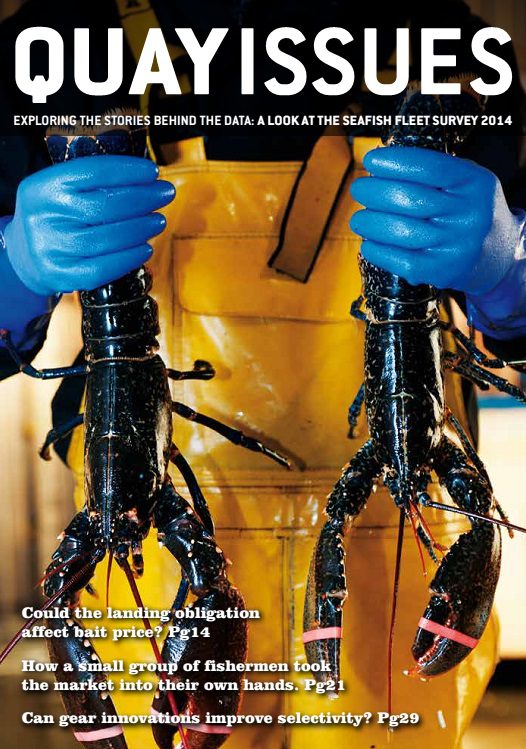
This year for the first time Seafish have produced a magazine to celebrate and share some of the inspiring stories that myself and my colleagues heard during our interviews with vessel owners. Quay Issues discusses the main challenges described by vessel owners and features case studies to illustrate how some are overcoming these challenges. We cover topics including how to reduce spending on fuel, modifying gear to reduce discards and how spatial agreements can reduce conflict between sectors.
To claim your free copy of Quay Issues, please write to us at: kirsten.milliken@seafish.co.uk with your contact details. If you would like to get involved with future surveys please write to our Data Collection Project Manager, Steven Lawrence at: steven.lawrence@seafish.co.uk.
Barrie Deas, Chief Executive of the NFFO said:
“At the outset of this
process the fishing industry had very great concerns that this would be a tick box exercise which could lead to a
massive displacement of fishermen from their fishing grounds”
“I am pleased that Defra have rejected a wild, rushed approach
in favour of one based on building a solid knowledge base on which to make
these important decisions. We do believe that marine protected areas have an
important role to play in protecting vulnerable features and habitats. But they
must be sited in the right locations for the right reasons and to do that it is
essential to gather the necessary data. This is science versus empty gesture
politics.”
“18 of these new sites are in inshore zones where there are
particular sensitivities from both a nature conservancy and a fishing point of
view.”
“As this process goes on it is important that we keep talking
to Defra especially about those sites in the South West and Irish Sea where
decisions have been deferred.”
The Federation is encouraging the industry operating in the vicinity of individual sites to get involved in the consultation. Full details of the consultation can be found here.
The practical effect of following Greenpeace’s policies could leave much of the UK quota uncaught, undermining the nation’s food security and putting the country’s national dish at risk. As a knock on effect of this, the proposed policies could also result in fish consumption becoming the exclusive preserve of the rich as prices at niche markets supplied by small-scale local fleets would be unaffordable to most British families.
The NFFO, which represents fishermen of all vessel sizes, has stated that whilst the proposed court action will help to shine a spotlight on the quota issue and help to bring clarity to an issue which has become bogged down in distortions and misinformation, the grounds for the case are delusional.
NFFO chief executive, Barrie Deas, said “So much nonsense has been spoken by Greenpeace on the issue of quota distribution and the sustainability of large and small-scale fishing that a court case which scrutinises the real issues can only be a good thing.
“As well as threatening the affordability of fish, greater allocations to the smaller inshore vessels could result in these waters becoming overfished as competition displaces vessels to previously sustainably fished areas. ‘Robbing Peter to pay Paul’ is simply not the answer.”
“Despite Greenpeace’s claims that they champion small boat fishermen, they have once again failed to think through the practical implications of what they are proposing. The UK’s need for a diverse fleet of large, medium and small vessels to take advantage of all its fishing opportunities is vital to the industry’s interdependence in supporting port infrastructures and ensuring continuation of supply.”
While there have been periodic acute shortages of quota in some under-10 metre fisheries, these resulted from a number of different factors, most of which were unrelated to the internal distribution of quota in the UK. The overall reduction in EU Total Allowable Catches since 1990 together with restrictive EU policies, for example towards skates and rays are among factors much more significant than the internal distribution of UK quota between small and larger vessels.
In recent years the NFFO has advanced a number of ways to address the underlying issues of quota shortages in the under 10 metre fleet. Championing more responsive management at EU level and by regional member states, providing high-catching under-10 metre vessels with more effective quota management systems equivalent to those already enjoyed by producer organisations and strengthening industry cooperation are just some examples of work being done by the NFFO and its members to safeguard the future of the UK’s diverse industry.
Deas continued: “All of this is a million miles away from Greenpeace’s cynical toytown fantasy narrative of evil pantomime villain monster vessels. The under-10m fleet is a vitally important component of the UK fishing industry and it is of the utmost importance that it is put on a proper sustainable footing. This will not be achieved by Greenpeace’s distractions and grandstanding.
“There can be merit in using quota to encourage more sustainable ways of fishing. However, it is simply nonsense to say smaller vessels automatically fish more sustainably than large vessels. It all depends on the management regime and what the vessels are doing, not their size.
“Although there are always risks in going to court, we are confident Greenpeace’s shallow and frankly erroneous claims will wither under the spotlight of High Court action. Greenpeace must have made the judgement that the publicity, even of failed court action will justify the costs. It is this deeply cynical tactical thinking that has characterised Greenpeace’s intervention in fishing from the start.”
The Committee, which met recently in York, concluded that the forthcoming General Election meant that it was unlikely that progress would be made until the second half of this year.
“Nothing could be clearer than the need for an independent review of the Marine Management Organisation’s fisheries functions given the sequential failures if the Organisation to get a grip of its central functions and cross-party criticism in Parliament. Yet we are being fobbed off with the usual promises and evasions,” said NFFO Chairman Tony Delahunty.
“Shellfish policy is another area where there is absolutely no prospect of progress this side of an election. Getting capacity in line with available resources is the absolute fundamental tenet of sound management, yet the Government dithers about putting a cap on the number of high volume crab vessels, and witters about “voluntary measures”. Government inertia raises serious questions about how this fleet will be able to exist within the context of the western waters effort regime. It is abrogating its responsibilities.”
“It is clear that the implications of the landing obligation and knock-on consequences for adjacent fisheries like shellfish have not been thought through. But what are all those category B and C licences going to do now they cannot discard but have no quota allocations? There is only silence on these issues.”
“Bass is another area of concern. The Commission’s emergency measures are no doubt eye catching but they do not represent a comprehensive response that addresses all sources of fishing mortality, including the catch of recreational anglers.”
The Executive did take heart however, that the Federation’s work to challenge media misconceptions and distortions was making solid progress.
“Challenging lazy and sensationalist stories, whilst initiating coverage of the positive developments in our fisheries, had made 2014 a much more “fishing friendly” year in the media than the previous year,” said Tony Delahunty. “ we have agreed to continue this effort in 2015 with campaigns focused on sustainable fishing, the need for diverse fleets, fisheries science partnerships and food security.”
Discard Ban
Looming over the future are the implications of the EU landings obligation when applied to the demersal fisheries in 2016. The lack of clarity about what the discard ban will mean at vessel level – which species will be included and when? what exemptions will be available? how the ban will be monitored and enforced? what the ban will mean for quotas and quota management? – all await answers and in the meantime generate concern and uncertainty within the industry.
A DEFRA consultation on the demersal landings obligation is imminent but it is unlikely that much clarity will be available in the first half of the year. In these circumstances it is very difficult for vessels to prepare for the biggest change to the CFP since its inception.
Time of frustration and uncertainty
“All in all, given the inertia in government and the lack of clarity about the landings obligation, this is a period of great uncertainty and frustration in the industry, even at a time when the fundamentals – fishing pressure and stocks – are heading steadily in the right direction.”
For many people, the sea is nothing more than cold and grey. But in recent years there has been a growing public awareness of what is happening in the waters around the UK.

Conservationists have raised awareness of UK marine environments with calls for a network of marine protected areas, while possibly the most high-profile campaign has been chef and TV presenter Hugh Fearnley-Whittingstall’s “Fish Fight” on discards.
Celebrity chefs have also played a role in trying to broaden people’s fish choices, flagging up alternatives such as gurnard to the “big five” – although the Marine Stewardship Council has warned that a lack of knowledge over stocks of some species mean they cannot necessarily be considered more sustainable.
As an environment correspondent, much of what I write about the fishing industry relates to sustainability, for example stories on fisheries which secure MSC certification or the Marine Conservation Society’s latest assessment of “fish to eat” or “fish to avoid”.
But journalists are also keen to tell the human story behind a wider issue, and individual case studies can help illustrate complex issues facing the fishing industry and the marine environment from a different perspective.
It’s important too, to get all sides of a story, for example finding out from fishermen how policies such as the EU discard ban will – or won’t – work in practice.
Stories about produce gaining EU protected food name status, whether it’s Melton Mowbray pies or Cornish sardines, also tend to get a good showing in both regional and national press.
That ties in, I think, to a growing interest among many people in the UK about the origins of what they eat, in the face of increasingly global and complex food supply chains.
The scandal surrounding the revelations that horsemeat had been found in products such as burgers and lasagne last year threw into sharp focus the importance for food producers in this country of being able to demonstrate how and where their produce comes from.
After all, as one Cornish fisherman said to me recently, there’s no horsemeat in hake. It’s hake.
We are sad to convey the news that Mervyn Mountjoy, who played a very significant role in representing fishermen from the South West, died on Saturday 10th January after a long illness borne with bravery and dignity.
Mervyn was Chairman of the NFFO South West Committee in
the 1990s and will be remember for his commitment to the interests of
fishermen, his acumen and his gentle disposition.
Although his home was Bideford, Mervyn fished out of a
number of ports, notably Newlyn, in his trawlers Galilean and then Ocean
Harvester.
For many years after he retired from active fishing, and
had moved onto farming, Mervyn represented the small-scale commercial salmon
fishermen in the South West.
His soft-spoken but influential contributions to the NFFO
Executive Committee helped to shape national policy during a particularly
volatile period and will be remembered by all who witnessed them.
Mervyn had many friends, including many fishermen in
Brittany.
We offer our condolences to Gwen and his two sons.
Do fishermen within the small boat sector get the representation they deserve and do they even want or need that representation?
Firstly to share a lovely quote I often use when discussing difficult issues facing fishermen, when it appears that they are not all that interesting in engaging. “If you as a fisherman do not take an interest in your own future, someone else sure as hell will.” That of course applies equally, to the bigger boat sector.

Having started a fishing career spanning 30 years and starting out with a 19 ft beach launched boat, it is easy for me to understand that the small boat sector does not see the need for the level of regulation/enforcement and quota restriction that is currently aimed at them. The combined impact of the entire sector, not-withstanding the larger under-tens on fish stocks is pretty negligible. Furthermore, by their very nature they are polyvalent and for survival, need to be free to catch the fish which are accessible to them, as and when that fish arrives in their area.
Few fisheries’ managers and decision makers are aware of the catastrophic impact to a small boat fisherman, of having access denied to just a single species, when that particular fish may represent his income for the next 6 or 8 weeks.
Having also spent more than half of my career working in the bigger boat sector and seeing how regularly the goal posts are moved for those particular fishermen, it comes as no surprise that they demand a lot more time and effort, from those whose job it is to represent them. Despite the growing complexity of the regulation aimed at the big boat sector, they are in many ways easier to represent as they waste no time in knocking on the door, whenever something new and threatening appears on the horizon.
It is easy though to sympathise with the inshore men. They are often very hard working and completely hands on. It certainly isn’t a route to becoming rich in a short space of time. They are generally fiercely individual characters, who do what they do, despite the hardships, because it is the way of life they choose. Understandably they do not appreciate officialdom and people in white collars interfering with their right to make a living.
The NFFO fully realise this (thankfully so), and often refer to the fact that a healthy fleet is one where we maintain and support the full range of sizes, right from the smallest to the biggest. That message seldom reaches Brussels unfortunately.
The small boat sector plays a very important role, not just in the supply of fish to the marketing sector, but in the continuation of the culture of fishing throughout the British Isles. They are much more in the public eye than those that work away from sight of land and certainly they are often the target of recreational fishers who often view them as a threat to their sport.
While the solutions to how best to represent the inshore fishermen, are not easily found, there is a strong argument toward deregulating that sector. Much of what they contend with in terms of day to day regulation is either not appropriate or just unnecessary.
An example, so typical of the one size fits all mentality that often springs to mind, comes from a good friend who works on an 8 meter potter/long liner single handed. His MCA equivalent certificate, for his vessel was withdrawn when a spot check revealed that there wasn’t a full 9 metres of cord on his life ring. He put it to the surveyor in no uncertain terms that if he was in the water, it would not make an ounce of difference if the life-ring, which of course is then out of reach anyway, has 9 metres of line or none at all.
With all that in mind, my advice nevertheless to the small boat men refers back to the quote at the beginning of this blog. ”If you don’t take an interest in your future, make no mistake, someone else will and you probably won’t like it.”
Good fishing.
Don Thompson
President of The Jersey Fishermen’s Association
The federation has been at the heart of discussions between
advisory councils and member states, and says it is clear there is much work still
to do.
The NFFO’s chief executive, Barrie Deas, said: “You don’t
need a crystal ball to foresee that 2015 will be dominated by preparations for
the introduction of the landings obligation to the demersal fisheries from January
2016. Yet fishermen are waiting to learn how the discard ban will be phased-in,
what exemptions should apply to which fisheries and species, and must also wait
until December 2015 to find out about the increase in quota to cover the
unwanted catch that will now have to be landed.”
Many common public misconceptions still exist about an
industry which largely operates beyond the horizon. Thanks to a concerted
effort by fishermen, development of more selective fishing methods and a
reduced fleet size, discards have already reduced dramatically. In the North
Sea roundfish fishery, for example, discards have reduced by 90 per cent since
1994.
And yet, according to
the NFFO, credit for this often goes to celebrity campaigns such at Hugh’s Fish
Fight rather than the real and long term changes that have happened as a result
of the industry itself.
Mr Deas continued: “Due to the impact of a smaller fleet and
by working together with scientists, fishermen have seen discards reducing, by
up to 90 per cent in some places. But this is the sort of fact that goes
unreported and leaves the general public with the completely wrong view of the
industry.”
To combat the most pervasive and enduring myths, the NFFO
has created an infographic to tackle the top ten misconceptions, positioning
them against what is often a more positive reality, including the revival of
some of our most popular fish species including North Sea cod.
Discards
You don’t need a crystal ball to foresee that 2015 will be dominated by preparations for the application of the landings obligation to the demersal fisheries from 2016. Major issues still have to be addressed. These include: the scale of the quota uplift to cover the unwanted catch that will now have to be landed; how the discard ban will be phased-in, and what exemptions should apply to which fisheries and species. Member states must submit their regional discard plans by June of 2015 for these to be turned into law by the Commission through delegated act. The NFFO is already at the centre of the debates within the North Sea and North West Waters advisory councils on the advice to member states on these issues and it is clear that there is much work to do.
The major focus on the discards ban for the foreseeable future will not mean however, that all the other issues confronting the industry will just go away.
Maximum Sustainable Yield
We successfully argued in the run up to the December Council that a blind adherence to the 2015 deadline for achieving maximum sustainable yield:
- Was not to “follow science” but to apply a political aspiration masquerading as science
- Would result in serious socio-economic consequences for some fleets if not handled very carefully
- Will have to be interpreted in a flexible way if it is to be of use in mixed fisheries and multi-species contexts
- These issues will recur and will have to be fought repeatedly. It’s not as though fishermen are against moving to high yield fisheries. Why would they be? But a legal obligation to set quotas in relation to a rigid MSY timetable carries a lot of baggage which must be dealt with carefully.
MSY as a slogan is one thing. People’s livelihoods are something else.
Industry Reputation
Over the last 12 months have seen some further movement away from the standard media portrayal of fishing in terms that are unrecognisable to anyone in the industry. Working with communications experts Acceleris, the NFFO has worked to counter media distortions as they arise but also to ensure that the many positive aspects of fishing get a fair airing. Flagship BBC programmes such as Newsnight, and the Today Programme, which to some degree set the news agenda, have carried interviews in which the Federation has been able to articulate a different vision of fishing, as an alternative to the tired narrative of an industry on the edge of the abyss. The Times too has produced some balanced pieces and our hake initiative and social media campaigns have received wide coverage. There is no sign yet that we can ease up on this front, so 2015 is likely to see additional initiatives, including a set of videos on fisheries science partnerships; the link between fleet diversity and food security; discards; and marine protected areas. We cannot afford to let the fishing industry’s opponents dominate the news agenda, especially as we now have such a strong and positive story to tell.
Under-10s
The inshore fisheries and under-10metre quota issues are complex and multi-faceted. This is, no doubt, part of the reason why progress in formulating official policy in this area is taking so long. Acute quota shortage can be seen in some parts of the pool at some times of the year and in some regions, although in other areas and times there is little to choose between PO and under-10m allocations. Generally, everyone needs and wants more quota but the issue of what allocation system to use, the extent to which the market has a role, when or if it is appropriate for Government to redistribute quota, from who to take it (and equally tricky, who to give it to), is a minefield.
Into the minefield has blundered Greenpeace, fresh off the plane from desecrating ancient and fragile Aztec symbols, to advocate their simplistic solutions for our fisheries. One thing in this complicated area is clear. Whatever quota redistribution would mean in the context of the under-10 pool, it would not involve their so-called “monster” vessels, for the simple reason that the fish the larger vessels in the fleet catch are well offshore, or in distant waters, inaccessible to the inshore fleet.
More likely, redistribution would involve reallocating from an 11 meter vessel to a 10 metre vessel. And would it be a factor if, in the past, the owner of the 10m vessel had sold his over-10m licence and quota and moved into the under-10m pool because it was less restricted? These, amongst many others, are the difficult issues surrounding redistribution of quota and why the Federation has advanced an alternative approach based on bringing effective quota management to that small part of the under-10m fleet (around 14%) which catches 70% of the under-10m pool allocations.
Only one thing in this field is certain: if the answer is Greenpeace, you are asking the wrong question, my friend.
Marine Protected Areas
The Federation and the Marine Protected Areas Fishing Coalition successfully argued that MPAs should be designated and managed on the basis of evidence rather than through a panicked tick-box exercise which does neither fishermen nor the marine environment any favours. Much detailed work remains however to ensure that establishing a network of marine conservation zones is a rational process, is informed by the best available science, and fully takes into account the interests of fishing businesses and communities.
Safety
We were very pleased that our initiative to bulk-purchase, grant supported life jackets (PFDs) and make them available to fishermen free or at nominal cost, was taken up by many other organisations. We hope that this will contribute to PDFs being worn routinely on deck throughout the industry. This was an important initiative but only one aspect of the NFFO’s work in this field, which covers all aspects of safety and training mainly through the work of our safety and training officer, Robert Greenwood.
Shellfish
The NFFO’s Shellfish Summit in Greenwich, in October, usefully focused attention on this important sector. Following up the conclusions of the Summit has already begun but will continue in 2015. Ring fencing the high-volume end of the fleet is in our view a precondition for putting the whole sector on a sustainable footing. Breaking the official inertia that has prevented forward movement on this and related issues will be a priority for the Federation in 2015 as will bringing some semblance of sense to the Western Waters effort Regime.
Conclusion
In this note we can only provide a flavour of the issues which the NFFO will be dealing with in 2015. Our Executive Committee will meet on 14th January to review the work ahead.