

Chief executive Barrie Deas, explains why Marine Protected Areas aren't the solution to managing fisheries.
Former Fisheries Minister Ben Bradshaw recently led the charge to resurrect the campaign for the immediate designation and implementation of 127 marine conservation zones around the UK. In a confused and somewhat bizarre article in the Independent, he made the argument that marine protected areas were the solution, not just for not just managing fisheries but for just about everything other ill on the planet, including climate change.

I felt compelled to respond, pointing out that over-selling marine protected areas as a panacea was not wise, either for fisheries or for the marine environment.
MPAC, (the Marine Protected Areas Fishing Coalition) brought together fishing interests, including the main UK federations and a number of European fishing organisations, to oppose exactly this kind of hasty, poorly-considered rush to implement marine protected zones. MPAC was successful in persuading both the Government and the statutory nature conservation bodies, that marine protected areas have an important role to play but if they are to be of benefit they must be based on good evidence of what it is we are trying to protect, what that protection should consist of, and dealing adequately with the issue of displacement of fishing activity, where that is an issue.
Even some of the environmental organisations privately conceded that their battle cry of “MPAs Now” was not just anti-fishing but anti-science and weakened their position.
Taking time to gather evidence and to get things right, as opposed to an empty tick-box exercise has been the current Government’s approach and it is the right one. It is important that it continues throughout the process of implementing both domestic and European marine protected areas.
Marine protected areas, even areas closed completely to fishing, have an important role to play in some circumstances and the NFFO has in the past supported both where appropriate.
It is the shallow, populist, anti-science and anti-fishing lobby, now apparently led by the likes of Ben Bradshaw and Hugh Fearnely-Whittingstall, that we take issue with.
To read more of the December Council Report please click through here – December Council 2014
The Cod
Recovery Zone Rules have now been published and can be found at www.gov.uk/government/publications/manage-your-fishing-effort-cod-recovery-zone
The MMO has written to everyone who was eligible last year advising that the Cod Recovery Rules for 2015 are now available, including a Days at Sea Application Form. The MMO has asked that completed forms are sent to local coastal offices by the 9thJanuary 2015.
The MMO
would like forms to be submitted to local coastal offices by the 9th January 2015 so that can the applications can be processed and issue the
fishing authorisations issued in time for the scheme year starting on the 1
February 2015.
The Effort
Management Team will be unavailable from 22 December until 5 December.
The National Federation of Fishermen’s Organisations (NFFO) has said that EU ministers have struck a balance between protecting fishing livelihoods were protected, whilst continuing to rebuild fish stocks, when setting fishing quotas for 2015 at a meeting held in Brussels this week.
Despite pressure from environmental lobby groups, ministers took advantage of the flexibilities provided for them them by the Common Fisheries Policy (CFP), to reduce proposed cuts on a number of major commercial species. Celtic Sea Haddock’s cut was reduced from 41% to 12%, while the cut of Celtic Sea cod was reduced from a proposed 64% to 26%. Eastern Channel sole still faced a cut of 28%, mitigated from -60%.
The decisions were made at the annual December Council meeting in Brussels, where representatives of the UK fishing industry, reflecting the diversity of the UK fleet, worked closely with the fisheries minister throughout negotiations.
The decision comes at a time when the industry already faces pressure due to quota species needing to meet the gold standard of sustainability measurements, called ‘maximum sustainable yield’ put in place as a legal obligation by the 2013 reform to the common fisheries policy.
The devastating consequences of getting these decisions wrong was seen during the course of this year with the effective closure of the Bristol Channel fisheries which saw the displacement of the larger vessels, the need to tie-up smaller boats and the closure of the main fish processor with consequent loss of jobs. The North Devon Fishermen’s Association, one of the most active fishermen’s groups in the country, also faces closer due to the near collapse of the local industry.
The National Federation of Fishermen’s Organisations chief executive, Barrie Deas, said: “Inevitably, the decisions made by ministers have been seen as a test between competing visions: strict adherence to the principles agreed in the 2013 CFP reform, versus a more pragmatic approach, which pays due attention to the socio-economic consequences of severe quota reductions.
“We were determined to get the balance right between continuing to move steadily towards high-yield fisheries, whilst safeguarding the livelihoods of fishermen and the resilience of fishing communities and are pleased these priorities are reflected in the outcome.
“The Council certainly demonstrated it was prepared to put livelihoods before political dogma masquerading as science. There were always going to be winners and losers and some of the cuts will still have major impacts on fishing businesses and communities around the country but we are relieved that, for the time being, ministers have listened to our call to protect an industry that provides livelihoods to so many and such a valuable, sustainable food source to our island nation.”
“A phased ban on discarding of unwanted or over-quota fish begins from 1 January 2015 and this transition will be a major challenge for fishermen and the management systems.”
This week’s decision is the culmination of many years of working with scientists to reduce the impact fishing activity has on stock levels. A 50% reduction in fishing mortality, often painfully achieved, across all the main species groups, and across the whole North East Atlantic, beginning around the year 2000, have laid the foundations for sustainable fisheries now and in the future.
The worst hit stocks facing significant cuts are Eastern Chanel sole (28%) cod (26%), haddock (12%), whiting (14%) and Bristol Channel Sole (15%).
NFFO Chief Executive, Barrie Deas argued that there is no crisis in fish stocks in our waters that would justify anything like the 60% quota cuts proposed for some of our most important quotas. The science is quite clear. Since 2000, there has been a dramatic (in the region of 50%) reduction in fishing pressure for all the main species groups, right across the north East Atlantic. As a result, stocks are rebuilding, some rapidly, some more slowly, due to local circumstances and recruitment patterns.
Against this background, of generally increasing stock abundance, the NFFO argues that the quota reductions proposed by the Commission are driven by two main factors:
- By a legal timetable enshrined in the reformed CFP, to set quotas in relation to maximum sustainable yield by 2015
- Where the information held on specific species is poor, a precautionary 20% reduction is required
The NFFO underlined that fisheries ministers have it in their hands to depart from the MSY timetable, if justified on socio-economic grounds. And whilst it is sensible to take a precautionary approach to data limited stocks, year-on-year cuts of 20% is simply overkill and a misunderstanding of what the scientific recommendations.
Barrie Deas added “Fishermen aren’t opposed to moving progressively and incrementally to high yield fisheries. Why would they be? But they have to survive economically next year as well as achieving long term sustainability – and these proposed cuts threaten that viability. This year we already have the example of the Bristol Channel, where cumulative quota cuts led to a complete closure of the fishery. The larger vessels have been displaced out of the Bristol Channel. The smaller vessels are tied up. The local processor has closed down. 12 fish workers have lost their jobs. All this against the background of stable or improving stock levels. This is the “socio-economic reality” of knee-jerk quota reductions without a clear understanding of the implications.”
Adherence to the MSY 2015 timetable (which lets remember is a completely arbitrary date) would be to put dogma ahead of livelihoods.
“In my experience there is very little between conservationists and fishermen in terms of destination – long term sustainability within a fully functioning ecosystem. It is the timetable that is the point of dispute. And we hope ministers in these negotiations put real fishing businesses and real livelihoods ahead of slogans.”
Note
The Commission’s proposals, if followed, would require the following reductions:
Eastern Channel sole – 60%
Celtic Sea cod – 64%
Celtic Sea Haddock – 41%
Skates and Rays – 20%
Megrim – 21%
The contrast with the former Commissioner could hardly have been greater. Without prompting, Commissioner Vella expressed his eagerness to work with the fishing sector to resolve forthcoming challenges, and suggested a series of regular meetings with a mutually agreed agenda, with relevant officials in attendance. His view, expressed early in the meeting, that European fisheries should be managed in a way that does not sacrifice future sustainability but equally does not inflict unnecessary pain on fishermen in the short term, coincides exactly with ours.
The Commissioner also seemed to appreciate that fleet diversity is a vital component in a balanced fishery sector. Both small-scale fisheries and larger vessels have a vital but different role to play in providing employment, economic well-being, and continuity of supply, that is an essential part of food security. It was made clear to the Commission that the fishing organisations represented within Europeche/EAPO reflected that fleet diversity, with a membership comprised of both large offshore and external waters vessels and small-scale inshore boats.
Fishing Pressure and Stock Status
Europeche/ EAPO asked the Commissioner to pay close attention to ICES scientific advice which confirms that after 70 years of incremental increases, since the year 2000, there has been a dramatic reduction in fishing mortality across all the main species groups in the North East Atlantic. Stocks were responding, as expected, to this reduction in pressure. Some, like North Sea plaice, had rebuilt very dramatically, above anything seen in the historic record, whilst others, depending on local circumstances and recruitment, are rebuilding at a different pace. The Commissioner heard that the positive direction of stock trends, well reflected in the science, contradicts the doomsayers, who grab far too much media attention with their sensationalist catastrophe narrative.
Top-Down
The point was made to the Commissioner that the progress that has been made over the last twenty years, in putting the CFP on a rational and sustainable footing, has been done at a high and unnecessary cost. The history of the CFP, across structural policy, technical measures, resource policy, cod recovery/management plans, has been one in which successive initiatives had either failed completely or delivered much less than hoped for. In some cases they had made matters worse. It was now widely accepted that a top-down one-size-fits-all approach applied to the multiple diverse fisheries under the CFP umbrella would always be doomed to failure. The recent reform of the CFP had provided for regionalisation, the first step in a necessary decentralisation of decision-making in fisheries. However, Commission proposals, such as the ill-considered proposed ban on small-scale drift nets suggested that there remained some elements of the old, discredited ways of thinking within the Commission. It was important to evolve away from a model of governance that simply doesn’t work.
The Commissioner acknowledged the force of this argument and pointed to the new technical measures framework, on which the Commission is currently working, which would reserve broad brush measures for where they are absolutely necessary and would otherwise devolve detailed decision-making to the regional level and below.
Science
The meeting provided the opportunity to explain to the Commissioner, the transformation in relations between fishermen and fisheries scientists that had taken place over the last decade. Changes had taken place in both the industry’s mindset but also ICES’s attitude to engagement with fishermen and fishing organisations. Fishermen’s Organisation’s and the advisory councils now struggle to accept all the invitations offered by ICES to attend data-compilation, benchmark, and science strategy meetings. Fisheries-Science partnerships of all kind have mushroomed, in which scientists work on board commercial fishing vessels to gather data and strengthen knowledge. All this amounts to a revolution in the relationship between fishermen and scientists.
Range of Discussions
An extensive range of issues were covered during the course of the meeting, which went on well after its allotted time. Market issues, fishing vessel safety, external waters fisheries, marine strategy framework directive, EU Norway, data-limited fisheries, maximum sustainable yield, as well as the impending landings obligation, were all discussed in more or less detail.
Conclusions
This was a highly constructive meeting which offers the prospect of a much better working relationship with the Commission than seen during the former Commissioner’s period of tenure. Both the Commissioner and Europeche/EAPO expressed their commitment to work together in the main policy areas and the Commissioner seemed to have a balanced view of his dual role as Commissioner of both Environment and Maritime Affairs.
Despite having been in the post for a relatively short period, the Commissioner, displayed an impressive grasp of the detail required to understand both the issues but also the labyrinthine politics associated with managing fisheries these days.
Time will tell whether this positive start signals a new era, or continuation of the same business under new management. We hope and will work on the basis that it is the former.
In a recent statement, the NFFO has argued that the Minister’s decision to reject calls for an independent review of the Marine Management Organisation’s fisheries functions is a mistake.
In a reply to a Federation open letter, Fisheries Minister, George Eustice, has argued that if there have been problems with the MMO in the past, they are now on the way to being resolved.
The NFFO has responded as follows:
“The problem is that we have been trying this ad hoc approach for some time now, with no sign that it is making any difference. MMO Chief Executives have come and gone and still the organisation shows no sign of getting a grip on its central functions.”
“The Minister seems to show little awareness of the breadth and depth of the malaise affecting the body that holds fishermen’s livelihoods in its hands. Fooling himself that all is well in the essentials is to gamble with those livelihoods. The catalogue of problems is too wide and appears to be too deep seated, to be dismissed with soothing words. They include data-collection and data-management, quota and effort management, vessel (satellite) monitoring systems and electronic logbooks, as well as the administration of EFF grants.”
“When a former DEFRA Director of Fisheries takes the view that papering over the cracks in the MMO won’t work and that an independent review is required, it is time to listen. When numerous members of Parliament expressed the same view, as they did in the recent annual fisheries debate in Westminster, it is clear that a review is overdue.”
“You can’t help but have some sympathy for the MMO in all this. It is a body which had to start almost from scratch when in the transition from the Marine Fisheries Agency to Marine Management Organisation, and in the shift from London to Newcastle, it lost most of its staff and therefore, experience. It was also unfortunate in losing, in short order, both its first chairman and its first chief executive, after some kind of personality clash got out of control. For a long period there was a standard denial of any kind of deep seated problem although the evidence pointed elsewhere.”
“Since then, it has not been possible to fault the MMO, either for acknowledging that there are indeed a range of fundamental problems and for their willingness to address them. The difficulty lies in the lack of actual visible progress. Assurance has followed assurance but the problems on the ground remain legion and now forward progress can be seen. Political decisions lie at the heart of the MMO’s problems and we consider that it is going to take a political decision to fix them.”
“This is why a short, authoritative, independent review is necessary. If the MMO cannot heal itself, it is vital that the Government intervenes to put things on track. We cannot continue stumbling on with a dysfunctional delivery and enforcement agency, and with soothing words that add up to nothing.”
“Given the multiple challenges facing both the industry and the fisheries management systems posed by the impending implementation of the EU landings obligation, there is no time to lose in getting the MMO into a state that it can meet those challenges.”
“An independent review would be the quickest way to identify the underlying issues and get the MMO on to the road to recovery.”

The finger is often pointed at fishermen as being the direct cause of any damage done to seabeds in our waters. However, this is by no means the case.
The easy solution to the problem it seems is to convert an area into a ‘marine conservation zone’ (MCZ) controlling exactly what can and can’t be fished in the said area.
Folkestone has become the latest area to be selected as an MCZ, because of an abundance of Spoon Worms in the area, a species nearly unique to the South of England.
I recently attended a meeting to come up with an agenda to finance a scientific investigation into the damage that ground trawling does to the sea bed in Hythe Bay. Expectedly, the usual suspects have made calls for a total ban on all fishing until the area is ‘recovered’.
But what equates to ‘recovered’? We have no benchmark for this and no information on what these waters were like 100 years ago to compare it to. Of course, this is going to have an extremely damaging effect on the Folkestone fishing industry. There is no evidence whatsoever that fishing in this area has caused any damaging effect to the environment. Folkestone fishermen can also prove their gear has done no lasting damage to both the spoon worm and fish stocks, as both are so prolific in that area.
Compare this to the Thames where fishing has collapsed, where fishermen can only dream of seeing the catches of the Folkestone boats. The question needs to be asked, why is no scientific work going on in this area too? My fear is that ministers are waiting for the industry to totally collapse before it is ‘recovered’.
We continue to change the environment we live and work in. Many windfarms are now having problems with scouring; rocks and sand are being used to cover the cables and there is erosion around the turbines. It’s unfair that fishing gear is deemed to damage the environment, purely because it changes it! The ability to feed ourselves is in the national interest, is it not?!
Now it’s not a surprise to know that I’m food bonkers! Whether it’s eating, writing, cooking or producing, my life during and since professional sport has been dominated by the food industry. Particularly the health food industry. One of the main ingredients has always been fish for its amazing nutritional value but only recently did I realise the precarious position we all find ourselves in regarding availability.
This is not just about sustainability of the fabulously finned friends but of our whole fishing industry. The public have no idea of the commitment, the sacrifice and downright graft a fisherman tolls to provide us with such a selection at the counter or on a menu. The week long trips in dangerous rolling seas away from their families in the hope of flushing out a shoal. The insecurity of finances weighing heavily as each night passes.
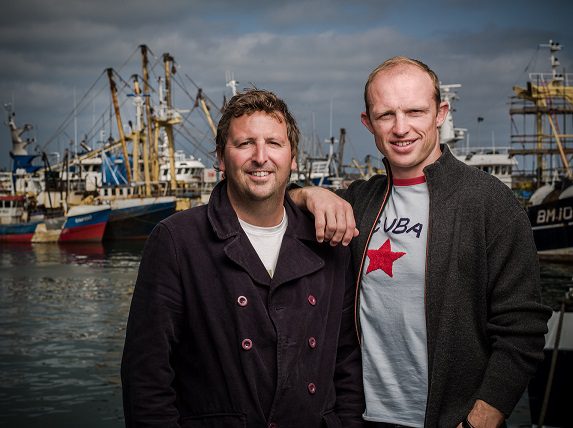
I experienced it myself in Brixham when filming ‘Mitch and Matt’s Big Fish’. Seeing some crews come back to the dock disappointed that their trawler would only deliver £100 to take home and yet the nets have been full of an array of species. Sadly it gets put back because us Brits are narrow minded creatures of eating habit.
What about the crabbers of Cromer? So reliant on its reputation and tourism yet who now goes to the seaside and orders a dressed crab and grabs a plastic fork. Candy floss is hardly a suitable substitute!
I always push for friends and family to try our amazing variety of fish. The gurnard, hake, pollock, bream, dabs, and halibut are just names that seem a little foreign. If only they knew?
From the generations of pilchard fishing in Cornwall cruising the midnight seas we have an awesome array of men and women doing their utmost to provide us and our families with fresh fish.
I salute you all and will continue to champion the ideas of eating the many varieties of seafood our British coastline has to offer. Please keep up the amazing dedication. My fish curry is legendary so my wife says, but we all know it’s in the ingredients not the cook.
To contribute to the blog, please contact nffo@nffo.org.uk
Ex-England rugby star Matt Dawson
has launched the National Federation of Fishermen’s Organisation’s (NFFO) new blog with an article praising the work of UK
fishermen and encouraging the British public to be more adventurous with the
species of fish they try.
‘Fishing Matters’ is the NFFO’s
latest initiative highlighting the great work happening in all sections of the
industry. It’s also a way of providing a platform for small scale fishermen to
have their voices heard and share best practice with one another, as well as
acquainting them with processors, supermarkets and consumers, strengthening
relationships and creating links within the industry.
Matt is a self-proclaimed fish
enthusiast and created the TV programme ‘Matt and Mitch’s Big Fish Recipes’ in
which he accompanied Michelin Star chef Mitch Tonks on a foodie’s adventure of
the UK. The pair travelled the UK coast, making pit-stops in fishing bays up
and down the country and cooking a host of fish recipes. In his blog entry, the
Question of Sport panellist commends UK fishermen for their hard work and says
the public has ‘no idea of the commitment, the sacrifice and downright graft’
it takes to provide a constant, diverse food source.
Barrie Deas, Chief Executive of the
NFFO, said: “As an open, outward-facing organisation, the NFFO is keen to
provide a platform for dialogue to those with the interests of the fishing
industry at heart. We have already managed to gather a great variety of blogs
from industry experts throughout the catching and consumer sectors, as well as
processors and supermarkets. The blog is a true representation of the effects
of the work of fishermen.”
‘Fishing
Matters’, which is being hosted on the NFFO website, also includes a
contribution from Matt’s fish food partner Mitch, who provides advice to
fishermen on making their catch as desirable to chefs as possible to command
higher prices at auction. The NFFO has already received further contributions
from a Press Association journalist, the UK’s seafood authority Seafish, and
fishermen themselves.
In 2013, 12,150 British fishermen
landed 624,00 tonnes of sea fish in the UK, amounting to a value of £718m – all
from a range of small, medium and large fishing vessels.
If you would like to contribute to the blog please contact nffo@nffo.org.uk

Fishing is a complicated and hard job and downtime off the water means no money coming in so that desire to land and return to sea must be a natural one. I wonder how many fishermen think about their product beyond the quayside and think about how they can add value to the catch by doing things differently. From the fisherman’s perspective what is there that can be done?
But from the chefs perspective there may be things.
I was in Australia filming a few years back and looking at how fishermen had coped with the huge controls placed on fishing and still made a living; the answer was simple, if I catch less, I need to charge more. Some fishermen worked with chefs in seeing what it is they wanted. The best example I saw was a snapper fishermen who had gone from catching big volume to very small, he got to understand that the levels of quality directly affected his price and gradually progressed to instead of landing the fish on board and icing them, he killed each one with a spike through the head (an old Japanese method) then placed the fish in iced slurry, the fish were in the best condition they could be and their prices rocketed on Tsukiji and Sydney market, other examples were crab and lobster fishermen making bespoke products for chefs like lobster medallions, their investment was in taking the time to understand and using their expert knowledge to develop specific pieces of equipment to freeze and process fish.
This progress was made by fishermen and the end user talking together and understanding better each other’s needs. It would be a good forum to get likeminded chefs and retailers together to chat and help each other see beyond and past the quayside.
To contribute to the blog, please contact nffo@nffo.org.uk.
Ben Bradshaw’s letter in the Independent on
Sunday is a call to arms for the immediate designation of 127 marine
conservation zones across UK waters, supposedly designed to protect our seas
against a ‘climate change battleground’.
Not
only is he championing a campaign that is a mixture of inaccurate information
and over simplification. It is one that defies scientific evidence.
One point in which he is not wrong is that in
the early 2000s fishermen opposed drastic reductions in the quotas for North
Sea cod. However, he draws the wrong conclusion. Fishermen argued that a
recovery policy based on slashing quotas, would, in a mixed fishery like the
North Sea, have only one result: a dramatic increase in discards. The quotas
were slashed – by 80% over two years – and the result was that for a number of
years for every cod landed one was discarded. The recovery of cod, in spite of
this myopic policy, can be attributed to a number of measures. The reduction in
the whitefish fleets by two thirds, mainly through a series publicly-funded
decommissioning schemes, was the main factor.
These are a number of reasons why the
campaign does not need to be resurrected:
- Closed areas did not play a significant role
in rebuilding the North American cod stocks in the 1980s. He seems to have made this up. - Bass stocks have not “collapsed.”
Poor recruitment and high fishing pressure (both commercial and recreational)
have led to a decline in biomass. It is important to introduce balanced and
proportionate constraints to reverse this trend. What this has to do with his
central thesis: the immediate reduction of 127 marine conservation zones is
hard to discern. - West Country boats are not tied-up, as he
implies, because of overfishing of skates and rays but because of quotas
drastically reduced to meet a short-sighted and arbitrary policy timetable. Ray
catches in the Bristol Channel have not varied more than 3% over the last 7
years. - The spurious link that he makes between
marine conservation zones and climate change is just baffling.
This is a disturbing mishmash of ignorance
and misleading assertion. It has at its heart the notion that marine
conservation zones are a panacea for all the ills of the marine environment,
indeed the world, when they are not. Well designed and situated marine
protected areas have an important role to play in protecting vulnerable marine
habitats and species. They are not a panacea or substitute for a range
alternative fisheries management measures which are successfully rebuilding our
fish stocks. Since the year 2000, fishing pressure across all the main species
groups has been halved and fish stocks are responding, some very dramatically,
like North Sea plaice, others more slowly, as we would expect.
There is a very good reason why the
Government’s policy of implementing a network of marine conservation zones,
carefully and progressively is the correct approach. It is not in nature
conservancy’s or in the fishing industry’s interest to put marine protected
areas in the wrong place. Only if you are content to have tick box exercise,
rather than effectively protecting the marine environment could you support the
call for a rushed process driven by gesture politics.
The signatories to Ben Bradshaw’s letter
should know better. Indeed many of them do know better but chose to go along
with a simplistic campaign because it carries a clear but misleading slogan
which they hope the public will support.

I have been fishing now for nearly 25 years and in all of that time, the decisions that really matter, on how we fish and by what amount we can catch have been controlled by people far away miles from the sea, who most of us have never met.
The decisions that are made in Brussels by the EU have had a huge impact on how we run our businesses. We are often left wondering how simple policies, have been made so complicated and bureaucratic, that once they are introduced to industry level, they just don’t work.

I think that with the introduction of the discards ban, the bureaucrats have bitten off more than they can chew, and for once in their lives they are looking for someone else to come up with the answers.
This time it has to be the industry which leads the way, and I am sure that if we step up to the challenge, we can meet it. As long as the commission are prepared to rip up the rule book and afford us more flexibility to run our businesses as we know best, so we can deliver the clean fisheries we know we can achieve.
For the last two years our vessel has been involved with the catch quota scheme, each year the bar has been raised in what we are expected to deliver. This year we have been running a fully documented catch on 3 species.
Adjusting to what is in effect a discard ban trial on 3 species has not been easy, but we have found our way through and we have met the challenges that inevitably get thrown at fisherman, through the course of a year.
This year we were faced with a big problem, we had a huge influx of juvenile haddocks entering the stock. This on the face of it was a good sign as it proves that the stock is healthy and it will receive a huge recruitment year class. However as a fisherman working with the cameras and having to count every fish against our quota this was a problem.
I felt like tearing my hair out in the beginning, but the crew and my brother and I put our heads together and we came up with a plan.
We needed to filter the juvenile haddocks out of the net, and we knew that a square mesh panel in the stocking wouldn’t be effective enough. So we took the decision to put the SQMP in the cod end of one of the nets, we are twin rigging, so the other net we left as a control.

At first we made the panel quite small, about 7 meshes across and 15 deep, just to see the impact. After the first haul we saw instant results with 50% less juveniles in our catch.
We found that we were still retaining more haddocks than we would of liked, we reckoned this was due to the panel not being big enough and that we needed to place it further down the cod end.

We ended up with a panel 10 meshes wide and about 30 deep it started 2 meshes up from the cod line, and nearly up to the choker rings.
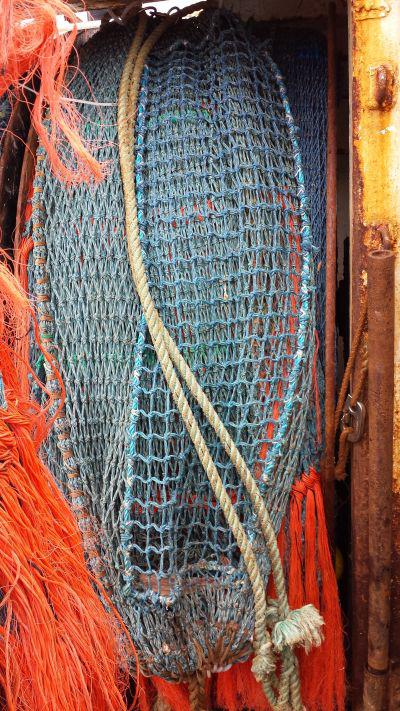
This proved very effective, and we have been averaging around 90-95% reduction in haddock juveniles and it will filter them up to 38 cm in length, which is a size 4 market grade.
We are working 100mm double 4mm netting in our cod ends and we simply made a SQMP out of the same material and fitted it in place as we needed to.
When I said earlier about ripping up the rule books, this is a good example how the rules actually impinged on our ability to deliver effective measures to reduce discards. This set up is illegal, as we should have only 5 meshes in the salvage, as it is classed as a SQMP just like the regulatory one in the stocking, we have 10 meshes each side up to the slavage.
What we have learned most from this is that if we are given the flexibility to go about our work as we are faced with the challenges, then we can deliver on the top down policies.
We have been lucky that we have had support from the MMO who allowed us to run the two nets alongside to see the results and supplied the dispensation to be able to do this.
We also had CEFAS aboard on our last trip who have backed up the CQT data we have done. They also assessed the whole of the catch, and we have reduced all discards by a very large amount.
We also had an economic impact report done on the loss of other fish, which will be released soon, but it is minimal and for us in our fishery this seems to be an effective tool.
The discards ban as it stands now, poses the industry with a huge problem, from what we have seen so far being involved with CQT, the quota’s needs to be more flexible, as do the technical rules.
Their is also a political problem with relative shares of differing member states causing a problem when you apply a discards ban to a mixed fishery. If you take area 7 where we fish for example, then the average UK share is just over 21% of the EU TAC, however on some species this is only 7-10%, and they just so happen to be our potential choke species.
Which is of no surprise to us fisherman but before any discard ban is introduced for these species then this has to be addressed.

What has been good, is that the agencies in the UK who are tasked with delivering this are working with the industry and are working well together. The MMO seem to well understand the problems that we face, and CEFAS are starting to realise that the way we manage stocks at present, will not work very well within a discards ban.
Our industry needs to take control of this situation, explain what we can achieve and what is stopping us from meeting the aims of the discards ban. Then we should guide the management side through the process of how to deliver a fully documented and clean fishery, through workable stock management and technical rules.
This will have to take the simple form of carrot and stick approach, greater compliance from a vessel should be rewarded with more flexibility, the problem we have is to ensure trust on both sides and from what I have seen cameras are the most effective tool to deliver this. This doesn’t have to mean big brother at sea, one vessel from each metier could measure fleet activity as a whole quite effectively.
This needs to be done at a more regional level and allow us to implement what we need in our specific fisheries, one rule fits all, should be the only thing that is banned.
This post originally appeared on the Crystal Sea Captain’s Blog.
To contribute to the blog, please contact nffo@nffo.org.uk.
If those proposals are accepted by the Council of Ministers on 16th December, it can only mean one thing – that the kind of casualties already seen in the Bristol Channel this year will be visited upon other inshore fleets in 2015.
The scale of the proposed reductions are breathtaking, including:
• A 60% reduction in the TAC for eastern Channel sole, a stock of central importance to the inshore fleet
• A 64% cut in the TAC for Celtic Sea cod, which will impact on a wide range of fleets including the under-10s
• Bristol Channel sole cut by 35%, when the existing quota was exhausted by June of this year
• Haddock in the Celtic Sea cut by 41%; another stock fished by a wide range of vessel sizes
• Skates and Rays in the North Sea and Western Waters face a further cut of 20%
If these proposed cuts had taken place against the background of a crisis in the stocks, it might have been plausible to argue that this very severe medicine is necessary to counter extreme overfishing. But they take place against the background of greatly reduced fishing pressure and a generally improving biomass for the stocks in our waters. These are not cuts driven by scientific stock assessments which indicate a serious problem with stocks. They are driven exclusively by a political agenda which forces an MSY timetable on decision-makers; along with a brutal approach to any fishery deemed to have insufficient data.
There is a direct contradiction between concerns expressed by a range of green organisations for notional small-scale fisheries and the lobbying activities of those same organisations at European level for an “ambitious” MSY timetable, which could well lead to the demise of a range of actual small-scale fisheries.
The scale of the proposed quota reductions, against the background of increasing abundance of fish stocks experienced on the grounds, could lead one to forgive those predisposed to conspiracy theories. But despite appearances, this is not a plot to eliminate the small-scale fisheries around our coasts. It is primarily the result of a blundering political decision, enshrined in law in the new CFP, to force ministers to set TACs according to a rigid timetable – MSY by 2015, or 2020 at the latest. Scientists, officials, ministers and, of course fishermen and fish workers, are now tied into a legal framework with very little room to manoeuvre. That was exactly the intention of enshrining MSY – a political concept masquerading as science – as a mandatory part of the new CFP.
For those who think that we are crying wolf, and don’t have the imagination to envisage the consequences of this scale of quota reductions, it is only necessary to look at the experience of the Bristol Channel this year: quotas so small, following cumulative reductions, as to become unmanageable; fleets displaced from the Bristol Channel; under-10m vessels tied up; the main fish processor closed; fish workers who have lost their jobs. This can only be the fate of other fisheries if these reductions are accepted.
Alternative Path
Since 2000, fishing mortality has been dramatically reduced across the North East Atlantic by around 50%. Stocks are rebuilding; some rapidly; some more slowly, depending on local and ecosystem factors. A rational, balanced and proportionate fisheries management approach would aim to continue this steady climb towards high-yield fisheries, without bankrupting the fleets. Even within the rigid CFP framework, ministers do have some scope to balance out the more extreme effects of the MSY timetable by setting TACs at a level commensurate with the viability of the fleets; and avoiding the unacceptable human costs of a repeat of the Bristol Channel catastrophe.
This will take political courage – to face down those in the green lobby and their friends in the media, apparently oblivious to the human costs of the policies they have largely been responsible for. It will take international cooperation – ministers will have to work together to avoid being isolated and picked off by concessions here and there. It will take a deeper understanding of the consequences of cumulative TAC reductions on fishing businesses and fishing communities. It will also take the intervention of the new Commissioner to ameliorate the dogmatic and damaging policies of his predecessor.

I’m an inshore fisherman, working an under-10m vessel, the Robert Louise, from Selsey, on the South coast. We fish for crab lobster, bass, sole, plaice and rays. Inshore fishing is highly seasonal so our target catch is dependent on what is available in our waters at any one time.
I’ve been fishing since 1975 and fishing has its ups and downs. The last 2 years have been amongst the most challenging in my career. First the cold winter of 2012/13 badly affected crab catches; and then the ferocious winter storms last winter that went on forever, meant that we just couldn’t get to sea. No fishing = no income. Many inshore fishermen like me are in the same boat.
I have been honoured to be elected Chairman of the National Federation of Fishermen’s Organisations and I took over my duties in May. The NFFO gives fishermen an opportunity to voice the industry’s views at the highest levels, whether in Whitehall or Brussels. And the Executive Committee, which I now chair, allows us to highlight problems that we see on a day to day basis. It’s very much a team effort. There is a huge amount of experience and knowledge around the Exec table from skippers of 6 metre vessels to operators of vessels that are 60 metres plus. And from all parts of the coast.
The major issues that we face at present on this part of the coast are the proposed drift net ban and bass conservation measures. The looming consequences of the EU landings obligation are a big worry too. The drift net ban, if it’s not blocked, could end many small scale- fisheries around here. It does seem to be an extreme example of the worst kind of EU one-size-fits-all approach. We support sensible conservation measures for bass but again, they have to make sense at local level. I am strongly opposed to creating a new TAC for bass that wouldn’t address the problems whilst creating a raft of new problems.
As for the landings obligation it is going to be all about the detail. It is essential for the authorities to talk to fishermen about how it will be implemented and what it will mean at boat level.
Fishing has been unfairly treated in the mainstream media in recent years and I am glad that the work being done is slowly turning the tide. Recently the Times, BBC Newsnight, BBC Today Programme, the Sunday Times and the Sunday Telegraph have carried stories that counter the usual stream of lazy and ill-informed nonsense. I am hopeful that my recent appearance at the BBC rural affairs committee will have helped in this respect.
To contribute to the blog, please contact nffo@nffo.org.uk.
This year’s autumn negotiations are especially critical as the main CFP policy drivers – maximum sustainable yield by 2015 (where possible) and automatic precautionary reductions where fisheries are deemed to be “data limited” – have led to proposals for huge quota reductions of between 20% and 60% in 2015. The recent closure of the Bristol Channel fisheries under the cumulative effect of successive quota reductions opens the realistic spectre of similar closures in other fisheries next year. The Federation’s primary role, given that the scientific assessments confirm the generally positive fishing mortality and stock trends in our main fisheries, is to oppose a fundamentalist application of the MSY timetable to TACs for 2015.
The NFFO has already met with Fisheries Minister, George Eustice, to express alarm at the implications of pursuing the MSY timetable and the Federation also played a prominent role in a recent stakeholder meeting with the Minister and devolved administrations in Belfast.
The Federation’s central messages at these meetings have been:
- The industry generally sees the sense in moving steadily and incrementally towards high-yield fisheries (bearing in mind that a steadily increasing number of stocks are already at MSY)
- However, the mounting evidence is that shoehorning all stocks into a dogmatic MSY timetable will have a serious unintended consequences, including:
Localised fleet collapses
Processors pushed into liquidation, with loss of processing jobs
Increased discards
Displaced fleets with knock-on effects in other areas/fisheries
Small vessels with limited range forced to tie up with their crews losing all income until the fishery opens again in January
- The experience of the Bristol Channel suggests that this outcome is the inevitable consequence of cumulative year-on-year quota reductions across a basket of stocks on which a local fleet depends
- The Bristol Channel is not an isolated example but potentially only the first in a list of casualties of cumulative quota reductions to fit the MSY timetable. We are approaching a tipping point.
- Government in its widest sense (EU and domestically) has paid insufficient attention to the cumulative socio-economic impact of successive TAC decisions
- If the Commission’s proposals (or anything approaching them) are applied, the experience of the Bristol Channel will be seen, as sure as night follows day, in other fisheries probably beginning in the South West and the South Coast, where some key stocks are facing huge reductions of up to 60%
A Rational Approach
A disinterested but informed outsider looking at the process of setting TACs for 2015, might conclude that:
- Since the year 2000, ICES science indicates that fishing pressure has been reduced dramatically across all the main species groups in the North East Atlantic, including those in EU waters
- Stocks have responded, and are responding, to that reduction in fishing mortality. The recovery is uneven. Some stocks are rebuilding rapidly, some more slowly, which is to be expected as after all, natural processes not just fishing is in the equation.
- In most of our fisheries these positive underlying stock and fishery trends will over time, lead to the high yield fisheries that we all aspire to
- As witnessed by the catastrophe unfolding in the Bristol Channel, it is entirely foreseeable that the essentially arbitrary timetable to achieve MSY by 2015, along with an equally fundamentalist approach to data limited stocks, will generate serious socio-economic casualties unless ministers intervene.
- The CFP regulation allows some flexibility to allow ministers to depart from the MSY timetable for socio-economic reasons
- We require a realistic and proportionate management strategy for TACs for 2015 that would continue the progress that has been made so far in rebuilding our stocks but would step very carefully where fishing business and communities are vulnerable to collapse due to their dependence on stocks that have seen successive, cumulative quota reductions
- As well as continuing our journey to optimum high yield fisheries, a fully rounded management strategy for 2015 would base TAC decisions on:
Mixed fishery considerations
Whether the decision will result in a reduction in fishing mortality or just an increase in discards
Socio-economic considerations, not just in relation to this or that single stock, but in relation to the totality of fishing opportunities to a specific fleet
Green Lobby
It is undeniable that the environmental lobby is now a significant force at play in all major fishing policy decisions and they tend to be especially vocal around the time when TAC decisions are made. The NGOs certainly were influential in shaping the CFP reform to include a mandatory obligation to base TAC decisions on achieving MSY by 2015. And we can expect their ritual denunciation of ministers who take into account mixed fishery and socio-economic consequences as part of their decisions.
What is less clear is what the NGO’s attitude will be to the unfolding consequences of following their policy, and in particular the forced timetable to MSY. When business casualties are seen, right across the fleet, affecting small artisanal fleets as well as larger vessels, will they still be urging ministers to move further and faster to implement MSY?
Fisheries are one of the oldest and most widely distributed of all marine activities in UK waters. Chances are that new marine uses will interact with existing fishing activities more often than with any other sector. But fisheries don’t occur everywhere with the same intensity, nor can the potential effects from new activities on existing fisheries be generalised. Some fisheries and fleets are more vulnerable to being displaced by new activities than others, and some are more likely to be able to co-exist within busy areas.
One of the key challenges is to decipher the level of importance of different fishing grounds so that they can be taken account of in a systematic way that maximises the chances of coexistence between different marine uses in marine planning decision making.
This isn’t just something of value to the fishing industry. A more efficient marine planning system that can account for the significance of fishing grounds in a strategic way is likely to minimise the scope for disruption or conflict later on, so we all have something to gain.
The purpose of the scoping the potential for core fishing grounds project (in future likely to be referred to as fishing interest areas) was to begin exploring the possibility of a spatial planning policy that can better recognise important fishing grounds. This included a MMO workshop which examined different marine sectors’ views on such an approach and explored the practical issues too.
Although the first East marine plans include a policy to reduce the likelihood of displacing fishing activity, they recognise that the existing fisheries evidence base is not sufficiently developed to support more prescriptive policies. Key areas to look at include evidence gaps and how to update policies to account for change (such as seasonal variations).
We also need to define levels of fisheries importance. Focusing on economic or social value or measuring levels of effort may be of use, but there is also the need to factor in displacement vulnerability; accounting for how far fishing vessels can range from port, and accessibility to alternative grounds if areas are lost. None of this is likely to be straight forward, especially given the number of data sets needed for any analysis, so stakeholder input and some level of qualitative judgement will be important.
If we can identify core areas, what then? Well, having such areas mapped would provide a signal about their particular sensitivities at the earliest stages when planning for other marine uses. The right evidence would also be needed to justify when other licensable activities could take place in such areas. It shouldn’t mean that planning in other areas where fishing takes place will be downgraded as a consequence though, as plan-wide policies would still apply.
Fisheries once pretty much had the freedom of the sea, but today it is clear that in our more crowded waters, defining the importance of fishing grounds is essential if our sector’s visibility in the marine planning process is to be improved. This work is an important first step, and if such a spatial fisheries policy can be realised it will probably place England at the forefront globally for recognising fisheries within marine planning.
This post originally appeared on the MMO Marine developments blog.
To contribute to the blog, please contact nffo@nffo.org.uk.
Possible alternatives to a zero TAC for spurdog (Squalus acanthias) are the focus of an NFFO led Fisheries Science Partnership project and the subject of a broad stakeholder meeting held recently in London.
Along with Cefas scientists, Defra policy officials, and NGOs, the NFFO has been working on the design of a pilot project that could provide some answers on how spurdog stocks could be rebuilt without impeding the main economic fisheries. The project has a particular urgency because zero TACs will not be compatible with the Landings Obligation. The stark choice appears to be to define spurdog as a prohibited species, (which will not address the problem of dead discarding) or permit a small by-catch allowance consistent with continued stock recovery, (which if not handled very carefully could become the ultimate choke species, preventing vessels from catching their main economic target species).
The London meeting was certainly successful in highlighting the complexity of the issue; but also in demonstrating unity of purpose between scientists, policy-makers, conservationists and fishermen; and did point towards some possible solutions. Cefas’ work on the spatial and seasonal distribution of spurdog was highly relevant and may provide the basis for a successful avoidance programme, if used within a flexible and adaptive policy approach.
Learning from experiences elsewhere on how it might be possible to avoid unwanted catch (in order to allow unimpeded access to the main target species) was an important part of the meeting; and in particular a presentation by Catherine O’Keefe of the University of Massachusetts gave much food for thought. In the New England fishery, the problem is relatively low value yellow-tail flounder which potentially acts as a choke on the high value scallop fishery. A real time reporting and feedback system which identifies areas in which high aggregations of yellowtail might be expected, was developed jointly by fishermen and scientists. This voluntary but quite sophisticated collaborative arrangement allows effective avoidance to keep the by-catch species under the permitted limits, thereby preventing it from acting as a choke.
No one is suggesting that we slavishly follow the New England model – except in that it demonstrates what can be achieved with a little collaboration, flexibility and shared information and insights to develop solutions tailored to regional circumstances.
In concrete terms, the next steps for the project will be to set up a trial to explore the issues associated with a limited by-catch approach, probably in the Celtic Sea. The number of vessels involved in the trial will depend on whether a spurdog allowance can be secured during this year’s December Fisheries Council as a departure from the zero TAC approach. It will not be lost on the Commission and Council that spurdog is but one of potentially dozens of choke species that may emerge as the Landings Obligation is progressively applied.
Speaking through their representative body, the National Federation of Fishermen’s Organisations, UK fishermen outside Scotland feel that their interests are in danger of being sacrificed to placate the clamour for more powers for Scotland.
NFFO Chairman, Tony Delahunty, said:
“There is clearly a strong momentum to give Scotland more self-government. Where we have a problem is in those places where those concessions adversely affect UK fishermen outside Scotland. The list of concessions under consideration includes fisheries, and in the past the SNP Government has shown that it has no qualms in disadvantaging fishermen in other parts of the UK if it suits their political agenda.
We are therefore calling for our own politicians to stand up for us when fishermen south of the border stand to be disadvantaged.”
There are two main items on the SNP shopping list which if accepted would have direct and adverse consequences for British fishermen outside Scotland:
1. A bigger say at the Council of Ministers in Brussels
2. Direct control of “inalienable” Scottish fishing quota
Council of Ministers: A dangerous and undemocratic precedent
The SNP Demands: Europe
“In areas such as fisheries, where Scotland has the predominant interest within the UK, Scotland should have the lead role at Council, where appropriate”
There must be no question of ceding further influence at European level in the Council of Ministers. The Scottish minister can already be invited by the UK minister to speak on issues with a particular Scottish dimension. That is quite sufficient. To give Scotland more formal powers would be constitutional nonsense and a grave mistake. It would set an unwelcome precedent but more importantly, it would create a democratic deficit. The UK fisheries Minister, when he speaks in Council, is answerable to, and held accountable for his actions by the Westminster Parliament, which is elected by the whole of the UK. A Scottish minister only holds a mandate from the Scottish electorate. To give the Scottish minister more formal authority, or “lead role” would break that important democratic mandate and disenfranchise our members. We could not tolerate that.
Every effort is already made to accommodate the aspirations and concerns of all UK fishing interests in international negotiations. To give Scotland a bigger say could only be at the expense of the rest.
Neither should the claim that assumption Scotland is predominant in fishing be taken at face value. More bulk may be landed in Scotland but it is a plain fact that the rest of the UK has more fishing boats and more fishermen than Scotland. Their interests should not be ignored in the post-referendum scramble.
It would be a travesty if these UK interests were sacrificed to buy political calm in Scotland.
Quota Management
The SNP demand on Quotas:
Scotland’s share of fishing quota should be inalienably held in Scotland
The SNP Government likes the flexibility to transfer quota into Scotland from other parts of the UK (indeed at present parts of the Scottish fleet would barely be viable without such transfers.) But they want this to be a one-way valve which would clearly put other UK fishing interests at a disadvantage. The SNP stance on NFFO quotas is strong on rhetoric but lacks equity or credibility. Scotland already (in 2008) tried to ring-fence “Scottish” quotas in a way which would have disadvantaged other fishermen in the UK. That attempt was blocked for very good reasons and it is important that in the atmosphere of post-referendum concessions, that our fishing rights are not given away to Scotland under similar guise.
Summary
The current level of devolution of fisheries regulation is not without its challenges. In many ways it adds a new level of complexity into an already convoluted area. However if the SNP’s wish list for fisheries was accepted, it would put a disadvantage other UK fishermen. We cannot accept that and we call on our politician to defend our industry from an asymmetrical deal at to the disadvantage of fishermen in the rest of the UK.
A series of TAC decisions set on achieving MSY by 2015 have resulted in a dramatic reduction in landings which have made the quotas unmanageable and led directly to the closure of the main local fish processor for the Bristol Channel; other fish buyers/processors will struggle badly. The cuts also look like triggering the demise of the local fishermen’s association, one of the most active and progressive in the country.
Those boats which can move away have been displaced out of the Bristol Channel to fish from south Devon, where the additional fishing pressure will not be welcome; the other vessels, which cannot move because of their limited range, are now clinging to a very precarious existence. This is a local level catastrophe which may be repeated many times over the next few years unless ministers take a different tack from the current policy towards MSY.
It is almost impossible to understand, and certainly impossible to explain to the fishermen involved, why against the background of generally stable or increasing stock levels, and an overall reduction in fishing pressure, this self-inflicted policy is being applied. It is particularly tough in the Bristol Channel where the industry have taken a number of ground breaking initiatives to protect their local stock.
The main commercial species on which the local Bristol Channel boats mainly depend, have now either been closed down prematurely, or have been restricted to unviable levels. The main policy driver behind this series of management decisions has been the push to reach maximum sustainable yield by the mandatory but arbitrary 2015 deadline. The final nail in the coffin has been the closure of the Area VII skates and rays fishery to all UK fishing vessels. The destroyed businesses and disrupted lives are the real cost of a dogmatic adherence to MSY now at any cost.
The Elements of the Crisis
The Bristol Channel fleets have been dependent on five specific TAC stocks. This year, one after another, each has been denied to the local fleets:
• Sole: the UK sole fishery in the Bristol Channel was closed in June due to exhaustion of the UK quota
• Skates and Rays: the early exhaustion of the UK’s allocation in October is driven by the very low TAC set at the December Council in conformity with MSY by 2015. The North Devon Fishermen’s Association has been at the forefront of introducing voluntary measures (a higher minimum landing size and closed nursery area. Although some of the 9 ray species caught in the commercial fishery have a poor conservation status, the species that fished by the Bristol Channel fleet [mainly blond ray] are stable. Annual landings of ray caught by the local fleet in the Bristol Channel have varied by less than 3% over the last 7 years.
• Cod: UK Cod quotas in Area VII suffer from a low TAC and low national share of the TAC. This results in very low monthly catch limits for most UK vessels fishing in the Bristol Channel
• Plaice: Very low restrictive quotas
• Spurdog: The zero TAC for spurdog means that dead dogfish have to be discarded bringing no economic benefit and not much if any conservation benefit.
Taken together, these restrictions on the basket of stocks on which they depend have pushed the boats in the Bristol Channel below the threshold for economic viability.
High Yield Fisheries
It would be difficulty to find a fisherman who would argue against the notion of a progressive step-wise approach to high-yield fisheries. The problem is that the scientific concept of maximum sustainable yield, which was developed in the 1970s for single stock fisheries, has been hijacked by a range of well-funded and politically powerful NGOs along with an authoritarian Commissioner, as short-cut, to “ending overfishing.” In this terminology “overfishing” is defined as any stock not fished at maximum (not minimum, mind) sustainable yield, and has been tied to a demanding mandatory timetable. This is what is driving the very extreme quota cuts currently being proposed by the European Commission. Some fisheries are facing 65% reductions for 2015. And this is also why the Bristol Channel is not likely to be an isolated exception.
The number of fish of any given species, in any given year, will be dictated by three main factors: fishing, natural deaths and recruitment (births). Fishing mortality across the North East Atlantic fisheries has been cut dramatically (by around 50%) since the year 2000. EU stocks generally outside the Mediterranean are rebuilding steadily, some rapidly, some more slowly. The speed of rebuilding is now mainly a function of recruitment and we have no control (or even much knowledge) about the factors that drive recruitment. And of course, the lower the fishing pressure, the higher will be the influence natural mortality (mainly predation). This requires a degree of patience. These are some of the reasons why a rigid and dogmatic approach to setting TACs in line with MSY is dangerous: dangerous for the wellbeing of fishermen, and dangerous for onshore fish workers and fishing communities. The Bristol Channel fisheries are suffering directly as a result of dogma put into practice.
Escape Routes
It may be too late for the fishermen in the Bristol Channel whose fate has been sealed by distant politicians and officials, but it is not too late to prevent a repeat for other fisheries.
The CFP legislation does allow for exceptions can be made for socio-economic reasons to allow for the achievement of MSY later than 2015, if ministers to exercise that option.
There are perfectly rational reasons, based on sound fisheries management principles, why it may not make sense to set TACs at the MSY level. These include:
• Mixed fisheries considerations
• Discard reduction
• Socio-economic concerns
The question is not whether such a departure is permitted (it is); the question is whether ministers (especially in an election year) can afford to be branded by NGOs with generous funding and powerful allies in the press, as the “the minister who failed to take the opportunity to end-overfishing.” Senior politicians have repeatedly stated their support for rural coastal communities but the harsh reality is that the level of commitment seems to slip away when push comes to shove.
Ministers therefore find themselves in an unenviable position: cut quotas in line with MSY and face the certainty that the experience of the Bristol Channel will be visited on other fishing communities; or face criticism from the NGOs that they have again “surrendered to the power of the fishing lobby.”
Commissioner
There is one unknown in this equation: the character and predispositions of the new Maltese Commissioner Karmenu Vella. His predecessor was the prime architect of the dogmatic approach to MSY, the consequences of which we see in the Bristol Channel today. A more pragmatic Commissioner could ease the way to a more balanced approach which would secure the jobs of fishermen and shore workers, without surrendering steady and incremental movement to the broad goal of high yield fisheries.
Fishing remains one of the most dangerous professions in the UK, with fatal accidents in 2014 already jumping up 25 per cent on last year. The National Federation of Fishermen’s Organisations (NFFO) is urging fishermen and anyone who works at sea to minimise their risk of accident by reading the latest Safety Digest from the Marine Accident Investigation Branch’s (MAIB) and by signing up for future editions.
MAIB’s Safety Digests provide anonymous case studies on the latest marine accident investigations and share useful information on how to avoid repeating the same misfortunes as others.
The NFFO’s Safety and Training Officer, Robert Greenwood, wrote an introduction for the Fishing Vessel section and said: “One of the best learning mechanisms is reviewing previous mistakes and understating how to avoid them next time. However, such is the danger at sea that sometimes there isn’t a next time. We would urge anyone who takes safety at sea seriously to read these free digests and learn from the misfortune of others, rather than becoming doomed to repeat their mistakes.”
The Safety Digests have been published several times each year since 1990 and are separated into sections for merchant seafarers, fishermen and those operating small crafts.
Based on MAIB official reports, the digests are presented in a magazine format for easy reading and omit names and specifics to provide anonymity to those involved. Each case study includes a narrative of the incident followed by a checklist of learnings that other skippers and seafarers can learn from.
Mr Greenwood continued: “In the last ten years there have been almost 3,500 accidents in the fishing industry with 94 lives lost. Reading these digests just a couple of times a year can help you avoid unnecessarily making mistakes that, at best, could result in an expensive fishing vessel being wrecked, or worse, you and your crew failing to come home to your families. These digests really are lifesavers.”
Subscription to the digests is free and anyone can sign up to receive them either by email or through the post. Sign up today by emailing maibpublications@dft.gsi.gov.uk, call 023 8039 5500 or get in touch by post at Publications, MAIB, Mountbatten House, Grosvenor Square, Southampton, SO15 2JU.
You can also read the latest digest online here: Click Here
Policy Drivers and Policy Inertia
Scene setting presentations were made by:
- CEFAS scientists, who provided an understanding of the current knowledge base on which policy decisions are made
- DEFRA policy officials, who situated current Government policy within the major EU policy drivers such as the Marine Strategy Framework Directive and CFP, MSY obligations and the landings obligation
- The Inshore Fisheries and Conservation Authorities, who provided an overview of the initiatives on shellfish being taken regionally within the 6 mile limit
- Shellfish Association of Great Britain, which summarised the history and frustrations in securing effective management measures for shellfish over 20 years
- The NFFO, which outlined the progress that had been made within the industry in defining a way forward for the crab and lobster fisheries, including:
A cap on the over-15m high volume crab fishery as a first step in dealing with latent capacity
Regionalised technical measures
An incremental step-wise approach, rather than grandiose national schemes which never reach take-off speed
Towards a Shared understanding
The very rich and sometimes boisterous dialogue which characterised the summit was an inevitable reflection of the wide mix of key players together in a room, discussing a subject on which passions can run deep. Inescapably, a wide range of opinions was expressed on different aspects of the shell fisheries. Nevertheless, three key issues surfaced above the others:
- Knowledge Base for Management Decisions
- Regionalised Measures
- Policy inertia in beginning to deal with latent capacity
Knowledge Base for Management Decisions
There was agreement that there is an urgent need for a long-term mechanism to involve fishermen in the collection of data relevant to the effective and tailored management of the shell fisheries. The science base has come a long way in recent years but is still an equally long way from providing the definitive advice and insights that are the necessary foundations for sound management decisions. DEFRA is working on this question but it will be for the industry itself to take the initiative. There are already examples of good practice and modern information technology can provide the means for effective but non-intrusive monitoring of fishing activities. There are important questions about what data is collected; who collects it; who owns the data; and what conditions are associated with its use. This will be the subject of intense discussion in the coming weeks.
Regionalised Measures
There is widespread agreement that the top-down, one size fits all, approach to fisheries management is even more inappropriate for shellfish fisheries than for finfish fisheries.
The inshore management authorities clearly have a central role in adopting and tailoring management approaches to the specific characteristics of their fisheries. It was clear from the meeting, however, that there can be considerable differences between IFCAs in their approaches to transparency and participative decision making. If regionalised measures are to be well-designed and broadly accepted, those IFCAS still wedded to “mini-top-down” management will have to accept that this outdated approach is likely to yield sub-optimal outcomes.
Policy inertia in beginning to deal with latent capacity
The NFFO and others in the shellfish industry first proposed a cap on the capacity of the high-volume crab fleet in 2011. This was not seen as a panacea but as a first step in an incremental process of dealing with latent capacity and effective management measures for the pot fisheries. DEFRA has variously ignored, questioned, prevaricated and dodged the issue but it has never been very clear why. Ministers have referred it to officials, who have shuffled the issue around creating an impression of policy inertia. Yet here is a policy that has the backing of the people affected and support within the wider industry, that makes sense in conservation and economic terms that if adopted would head off a range of future problems. It is somewhat of a mystery why this single proposal has failed to make headway but it has undoubtedly become a logjam for a range of other progressive initiatives in shellfish policy.
Landings Obligation
At first sight, the EU landings obligation would have less of an impact on the crab and lobster pot fisheries that the whitefish or pelagic fisheries that operate under TAC limits. However, the unintended consequences of management decisions is always a very real danger in fisheries and there is valid concern that the economic pressures generated by the forthcoming discard ban could impact on the pot fisheries as fishermen whose business models have been made unviable by the ban seek to remain in fishing by shifting across to shellfish. The EU cod recovery plans had exactly this effect on the transfer of fishing effort from the whitefish to the nephrops fishery. This potential danger was in the minds of all those in the summit as they discussed the future of the sector.
Summary
This summit provided a powerful wake-up call for the industry, regulators and scientists alike. The pot fisheries enjoy a number of important advantages, but if this economically vital sector is to avoid sleep-walking into a host of new problems it will need to address:
- Problems of managing the fisheries on the basis of limited data
- Regional management authorities which ought to be closer to the fisheries that they manage but in some cases cling to the old discredited closed, top-down styles
- Inertia in shellfish policy that has held progress in a vice-like grip, especially in dealing with the high-volume part of the industry, where a start should be made immediately.
“It is bad enough that we face a closure on this important
fishery in September with three months more of the year to run. But my fear is
that if this was repeated under the landings obligation then practically the whole
South East fleet would have to tie up or face the risk of prosecution. The
boats will be in the impossible legal position of not being able to discard the
fish, but not able to legally land them either.”
“This underscores the need for the regional discard plans, when
they appear, to provide a way out of this impasse. We know that conservation of
skates and rays are difficult because there are many different individual
species with different conservation status. But the solution definitely does
not lie with blanket measures and fleet tie-ups.”
“In the meantime, it is vital that the MMO does all it can
to get this fishery reopened by swapping in additional quota, domestically, or
more likely through an international swap.”