

Assistant chief executve, Dale Rodmell, reflects on Brexit, the disconnect between industry and the Common Fisheries Policy and the influence and role of environmental NGOs.
Fishing became the political poster child of the Brexit campaign. It’s easy to see why. More than in any other area of EU policy, the story of fisheries epitomises a sense of lost control and real loss as our industry bore the brunt of year after year of cuts at the hands of a distant invisible bureaucracy that gave the impression that it was oblivious to the livelihood needs of fishing communities. Changes to improve things to better connect industry to policy have also seemed slow and insufficient. In order to better understand the issues we now face following the Brexit vote it is worth examining the history of involvement of the fishing industry in the Common Fisheries Policy (CFP) and in more recent times the emergence of environmental NGOs as a significant influence.
The CFP Disconnect
Up until 2004 the only direct engagement the industry had with the CFP machinery was through the Advisory Committee for Fisheries and Aquaculture (ACFA), a forum of industry and representatives of fish workers that advised the Commission across the whole spectrum of European fisheries. As a single forum that only met occasionally it was grossly inadequate for the task.

The first efforts to change this state of affairs followed the crises of the 1990s that saw drastic cuts to whitefish quotas and to the fleet. From the discontent that was generated the 2002 CFP reform saw the introduction of the Regional Advisory Councils (now Advisory Councils). These were much more significant forums with secretariats to support their work and they gave industry a much more robust platform at a more appropriate scale to influence management decisions, alongside other stakeholders. But the Advisory Councils were not the be all and end all. Advice is just that. It has no direct role in setting management objectives and operational rules. There was wide recognition that involvement still needed to be deepened further.
The opportunity for that came with the regionalisation agenda under the latest reform. At the start of the process the Commission, in its Green Paper of 2009, had started out accepting that there was still something wrong with the relationship between fisheries governance under the CFP and industry. It said that:
“Very little can be achieved if the forthcoming reform fails to motivate the catching sector, the processing and seafood chain as well as consumers to support the objectives of the policy and take responsibility for implementing them effectively. It is critical to the success of reform that industry should understand the need for it, support it and have a genuine stake in its successful outcome. In a mostly top-down approach, which has been the case under the CFP so far, the fishing industry has been given few incentives to behave as a responsible actor accountable for the sustainable use of a public resource. Co-management arrangements could be developed to reverse this situation.” (CFP Reform Green Paper, 2009)
Almost as soon as it was printed, however, this whole agenda was all about to be side-lined. In contrast to what the Commission technocrats were thinking, Commissioner Damanaki had spent her time in office either aloof or hostile to industry. The European Parliament with its newly established powers under the Lisbon Treaty had little affinity for grand ideas of delegating responsibility to others when it had just been given responsibility itself. That, combined with the vast majority of MEPs having an almost complete absence of knowledge of the fishing industry, but their ears open to anyone who would tell them what to think, set the stage for the next command and controllers’ charter that we now see in the current CFP.

How did it turn out that way? Enter the eNGOs. Many newly self-appointed as the guardians of our marine resources and ready to fight on the beaches with a war chest mostly convoyed over from the USA. They got to work firstly with a doom-mongers blitz. Despite ongoing progress with cutting fishing mortality and the start of recovery being seen across the NE Atlantic stocks, according to them stocks were in free fall and heading for extinction – remember the 100 cod left in the North Sea story, and the 2048 end of line hype? In this altered reality, the inference was that industry couldn’t be trusted with the public’s precious natural resources. They had pillaged them, and always hood-winked their politicians into agreeing short-termist decisions, right? And there was an urgency to put it all right, if not by 2015, then by 2020 at the latest, no exceptions. Accompanying this narrative was heavy lobbying of the European Parliament to introduce a strict set of regulation to be contained in the core legislation, providing little flexibility for application at the regional level (see figure below).
Then, in the midst of it all, along came one of our celebrity campaigning chefs to lob in a discards PR hand grenade, straight into Commissioner Damanaki’s lap. It didn’t matter that a lot of the discards were generated by the regulations themselves and that significant progress had already been made to reduce them. In a matter of weeks the industry was handed it back, in-kind; the obligation to (nearly) not throw a single fish over the side…whilst trying to do a circus act to remain within the constraints of all of the other regulations. Actually, the circus act was left for another day – too hard for the hard working legislators to think about at that time. The megalomaniacs were back in charge, and once the deal was signed, congratulating themselves on the fantastic job they had done.
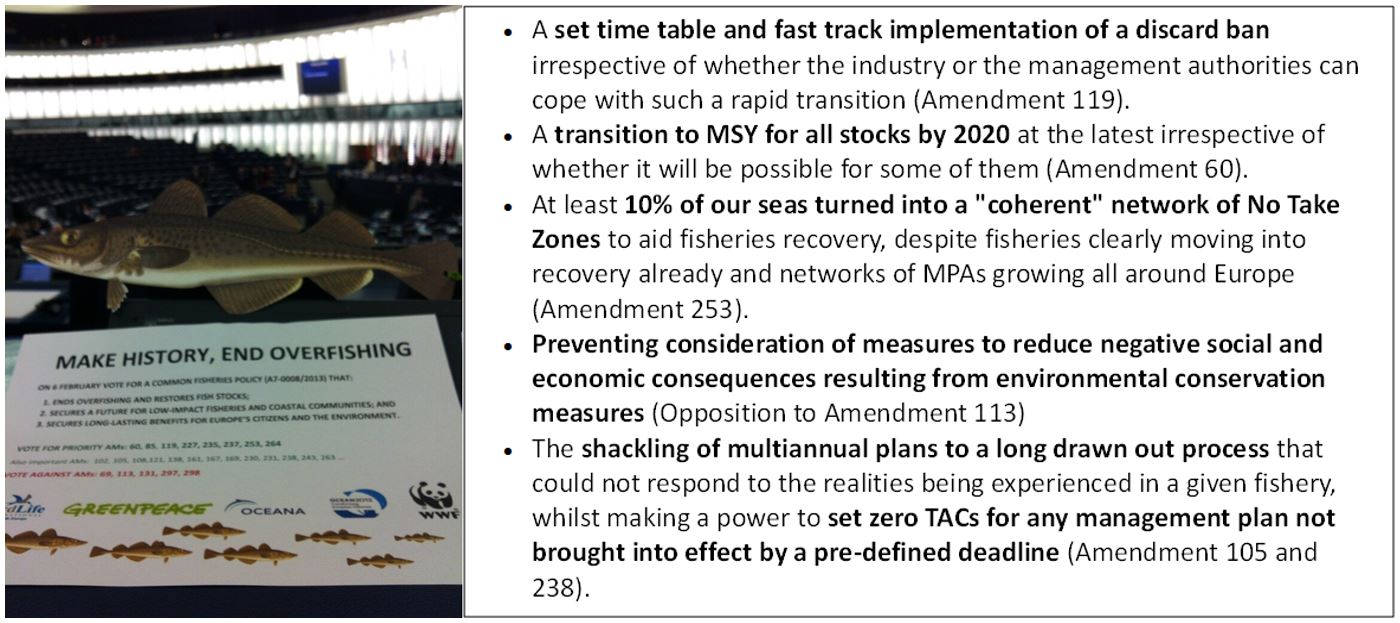
Indeed, a number of them still believe it, and continue to press for the toughest interpretation of the reform text. They continue to try to persuade decision-makers that the scientists have it wrong over setting stock biomass levels consistent with sustainable yields. They continue to lambast Ministers for TAC decisions that are different from the single stock advice without acknowledging their role in a legitimate process to consider, beyond this advice, the balancing the pace of reaching MSY with mixed fishery considerations and the likelihood of generating large quantities of discards. And they are working to try to set up a police state of electronic monitoring to hold the whole thing together.
Shared Objectives, Wrong-headed Delivery
To be clear, the NFFO has not been against the policy objectives of the CFP. Maximising long term yields is a good thing, as is minimising discards. But fisheries management can’t sit in an ivory tower and hand down these objectives as prescriptive management regulations attached with “plucked out of the sky” non-negotiable deadlines without an appreciation of how to deliver at sea and manage change, whilst maintaining viable businesses.
Tighter management has thus come along just when we have been witnessing of stock recovery on the grounds. Maximum Sustainable Yield (MSY) targets have delayed increases to quotas. Across fisheries that had received severe cuts the evidence base which is dependent upon the operating fisheries themselves, has also been undermined resulting in the increased application of the precautionary approach, which leads to reduced quotas simply due to lack of knowledge on stock status. New stocks such as skates and rays have been placed on quota but again with limited evidence they too have been subject to successive cuts as a consequence of the precautionary approach. All of these situations have led to more instances where fishing opportunities are out of sync with stock abundance.
Add the landing obligation (discard ban) to all of this and we are heading for a crunch as the responsibility for the mis-match between availble quota and abundance is transferred to the fishing business with the expectation that they can somehow perform the circus act and avoid breaking the law. And if they can’t, they tie up and go bust. That’s the prospect of what so called “choke” stocks mean, when the available quota of one stock has been used up but the stock can’t be avoided and so fishing for other species has to stop.
eNGOs and Brexit
The Brexit vote demonstrated in spectacular fashion that keeping those who are affected by decisions remote from decision-making and marginalised from the agenda, that politics can and does come back to bite. Of course fisheries formed part of a much wider leave narrative over governance, identity, democracy and exclusion, but it was used graphically in the leave campaign to make the point.
In the wake of the vote there is likely to be a lot of soul searching in the EU about how to better connect the supra-national institutions to national populations. But the influence of eNGOs that was prominently visible in the latest CFP reform, and their habit of lobbying for top-down command and control environmental policy from the centre, hasn’t gone away with the vote. eNGOs are not accountable to the electorate. And in Europe the UK probably has an eNGO community that is more active than in any other nation.
eNGOs didn’t want Brexit. A large amount of environmental policy is attached in some way to EU governance, and as some have argued in our EU referendum blog, fisheries and other environmental issues go beyond the reach of single countries. But already some are calling on the UK government to be tough on regulation and others are seeking to disenfranchise our industry by
claiming that we fail to understand sustainability and the conservation of natural resources upon which our industry depends.
Rubbish. A cursory glance at our website and the work we are involved in will prove that is not the case. Such an assertion reflects just the sort of attitude of blaming the people for their lot and trying to marginalise them from decision-making that is the cause of political ruction, certainly not a solution to it. Such eNGOs should hold a mirror up to themselves about what the vote represented.
I appreciate, nonetheless, that so far in talking about eNGOs I am lumping together a great number of organisations and stereo-typing them as one. That is unfair. Not all are concerned with implementing legalistic regulatory frameworks from the centre and not all work to demonize and control the fishing industry without having anything to do with it. Indeed, some have a more collaborative side. The Advisory Councils have been pioneering in bringing eNGOs together with industry. In the fruits of the consensus-based advice that they produce, they demonstrate what is possible.
Working in Partnership
There are also a growing number who are beginning to work directly to support industry. We in industry need to foster these relationships, whilst continuing to call out those who would rather work in the shadows and transmit falsehoods about our industry, ferment division and continue to pedal the doom-mongers narrative in order to justify their next grant or charitable donation.
There is a lot to do that could be achieved working in partnership. We must strive to improve the ability of industry to generate its own evidence to be able to help to plug the gaps in our fisheries knowledge base. We need to press ahead with management approaches that incentivise industry, undertaking trials and ensuring that what works is adopted more widely. We need to create a policy environment where fisheries management is not all about compliance with the rules, it is about shared objectives, shared management and mutual buy-in. We must show how that is a different and a better way to the centralising tendencies of top-down control.
What Next?
There are many governance models for our fisheries that may materialise post Brexit. There is nothing to say that one or other of the possibilities would not be some form of top-down control. Like any system of governance, when the pieces are thrown in the air they can so easily land with all the power greedily held at the centre or result with powerful lobbies dictating the terms. We will of course be working to see that whatever model it is, it is inclusive of industry.
I’ll close with a prediction. Fisheries will continue along the path to recovery and at some point the doom-mongers’ currency about our industry, like the boy who cried wolf, will be worthless. Those eNGOs that stick to it will either wither or go onto something else. The surviving ones still working in fisheries will be the ones that are actually supporting industry to sustainably manage its own affairs and celebrating what is possible. Bring on the optimists.
As part of its regular schedule of meetings, the executive committee of the NFFO met aboard the Kirkella, our 86m vessel, while it was docked in Grimsby in early March. One of the most advanced fishing vessels currently operating as part of the British fleet, the Kirkella shows the commitment of the British fishing industry as a whole to embrace innovation in an effort to become ever more sustainable.
However, the greatest strength of our nation’s fleet lies with its diversity. Technological progress is working extremely well, and is right to be commended, but we should not forget about the breadth of vessels that ply their trade at sea. While we have large advanced boats, 5,026 of the 6,383 vessels that make up the British fleet are 10 metres and under.
The sector relies on this mix of vessels to catch the incredible variety of seafood that we enjoy in the UK. Small boats cannot venture to far off fishing grounds to catch and freeze large hauls of cod, just as the larger boats aren’t suited to catching low volume but highly prized species close to shore.
It’s fantastic to see the effort that all fishermen have put in to ensure stocks are healthy, and it’s incredibly rewarding to see much of the latest science proving their efforts have been worthwhile. This has been achieved through the hard work and determination of fishermen across the entire industry, and their success deserves to be celebrated.
To see how the Kirkella fishes sustainably while contributing to the onshore seafood industry watch the video below:
Two things can be said with certainty:
1. At this stage there are more questions than answers
2. In this new world, fishermen will need a strong, cohesive, national organisation to defend their interests during the upcoming transition
It is not difficult to understand the strong anti-EU sentiments within the UK fishing industry. The European Commission has too often behaved with arrogance, and the EU Parliament with ignorance, to escape their share of the blame. To understand this, you need to go no further that the Commission’s proposed EU ban on small-scale drift nets – to solve an enforcement problem in Italy but which if adopted would have extinguished many sustainable, viable small-scale fisheries in the UK. This is but one example which just illustrates the roots of the frustration that has built over many years.
Promises have been made and expectations raised during the referendum campaign and it is now time to examine if and how they can be delivered. Unfortunately perhaps, the UK’s geo-political position means that it is not politically or legally possible just to ring-fence most of our fish resources in the way for example that Iceland can. The reality is that most of our stocks are shared with other countries to some degree or other.
We can certainly seek to renegotiate quota shares as well as access arrangement but it is realistic to expect that there will be a price of some sort. Who will pay that price is a critical question.
Some of the key questions in an immediate post-referendum context are:
1. What will the new bilateral (or trilateral) arrangements be for managing shared stocks? Will the fishing industry be part of the UK negotiating team?
2. What assurance will there be that fishing priorities will not be traded away against non-fishing priorities?
3. Will there be new access arrangements in UK waters? Will all foreign vessels be excluded from UK waters? If not, what conditions will apply if they are allowed in?
4. What reciprocal access arrangements will there be for our vessels to fish in the waters of other member states? What conditions will apply?
5. What quota share arrangements will apply? Will it be possible to negotiate better UK quota shares?
6. What market access arrangements will exist: to the EU single market and for external fish products in the UK? What tariffs will apply?
7. What status will domestic quota management arrangements have post Brexit? Will there be a grab for quota held by non-UK nationals? EU law will no longer apply but what will English law say?
8. What will the general economic climate be post Brexit and how will that impact on fishing? Where will the new equilibrium be?
9. What will the political context be, not least where power is currently devolved? Will there be a second referendum in Scotland?
10. Who will be doing the negotiating on behalf of the UK? DEFRA has reduced its team dramatically in recent months.
11. What say will the fishing industry have in shaping the new arrangements?
12. How will the transition to the new arrangements be managed?
Our Fisheries Minister, in campaigning for Leave, made a number of commitments including on the UK’s quota shares and access arrangements. With the referendum outcome, there will now be heavy pressure on him to demonstrate that there was more to those promises than pre-referendum sweet talk.
The one key lesson that we have all learnt from the CFP is that fisheries management is too important to be left to the technocrats. There are no technocratic solutions. Fisheries stakeholders, and principally fishermen and their organisations must be at the heart of the design and implementation of management arrangements. It is important that the politicians bear this in mind.
Whatever lies ahead, it will be vital for the industry to speak with one clear loud voice. History, not least the history of the CFP, demonstrates that divisions equals weakness. It is for that reason that the NFFO Executive, when it meets on 12th July, will be taking stock of the Referendum outcome and framing our policy accordingly.
The most salient features of the plan are:
1. The inclusion of cod and whiting into the landing obligation, conditional on dealing with the bits of the EU Cod Plan that are incompatible with the landing obligation.( For 2017 only whiting caught in larger meshes will be included)
2. The inclusion of haddock caught as a bycatch
3. Various applications for high survival and de minimis exemptions
The most salient features of the plan are:
1. The lowering of the thresholds, bringing more named vessels under the landing obligation than 2016
2. The addition of new targeted fisheries which have not yet been covered by the landing obligation
3. The addition of by-catch species to existing rules which do not represent a significant ‘choke’.
4. Various applications for high survival and de minimis exemptions
The formation of the IFCAs in 2010 under the Marine and Coast Access Act saw the replacement of Sea Fisheries Committees with these new bodies with greater responsibilities over marine conservation, as well as fisheries. This change also saw the relative dilution of representation from the commercial fishing industry on Committees as they accommodated greater numbers of representatives from other sectors, as well as conservation interests.
As well as this inherent shift in emphasis, the committee observed that the appointments process to the committees of IFCAs is constraining the successful recruitment of industry representatives for a variety of reasons including:
- An application process that is centralised with decisions on appointments taken well away from the regions in which the IFCAs operate.
- The process is an electronic one which discriminates against those without access to a computer or who have limited IT skills.
- Some application questions are tailored more to those who can provide articulate answers to abstract questions rather than those who have the greatest knowledge and experience of fisheries in their districts.
- There appears to be little constructive feedback for applicants who have not succeeded, which discourages future applications.
- The process overall gives the impression that the local knowledge and experience of the fishing community is not welcome and therefore seats intended for commercial fishing interests are being left vacant.
- In the absence of industry representation, as well as the absence of critical practical knowledge to underpin the decisions of IFCAs, decisions are at risk of lacking balance and having insufficient quorum.
Ron Graham, NFFO West Coast Committee chairman said: “The whole raison d’être of IFCAs is based on drawing on local knowledge and experience in order to manage local fisheries, and fishermen’s knowledge is crucial to effective fisheries management decision-making. It’s also necessary if there is to be a positive relationship between those who are subject to the rules and those making those rules. If we don’t have appropriate industry representation on the Committees the relationship between industry and authorities is at risk of becoming seriously frayed, if not broken.”
“In the case of the NWIFCA, up to 4 seats for commercial fishermen have at times been vacant despite the fact that local fishermen had applied to be on the Committee,” Ron added.
Other Business
The committee also covered a range of other issues affecting the industry in the eastern Irish Sea including:
- Discussing practices for operating static gears in the region’s offshore wind farms in order to promote safe working practices for both the fishing industry and offshore wind farm operations. These matters would be taken up further by the Barrow and Furness Fishermen’s Association.
- Reviewing progress and reaffirming commitments on work to assess the feasibility of establishing a community quota arrangement in the region.
- Reviewing developments in the implementation of the landing obligation, bass measures and the Federation’s efforts to work towards appropriate management arrangements for skates and rays.
- Discussing the recently introduced NWIFCA fisheries measures and efforts to rationalise bye-laws across the district and efforts among a range of bodies including the Federation to address the illegal trade in fish from unlicensed operators.
A major information campaign was launched this week in Fishmongers Hall in London. The campaign is supported by the NFFO, the Angling Trust and the British Hospitality Association, who all share the same concerns.
The trade in fish from unlicensed vessels is illegal. But the sale of fish from this source is a significant and growing problem. This campaign is about ensuring that no one misunderstands what is at stake: this is an activity that does real harm. It is a growing problem which if not tackled will have serious consequences.
We have conservation measures in place to safeguard our fish stocks and where they are being circumvented by semi-professional fishermen operating from unlicensed vessels, it is not something that we can or should ignore
The quantities that are being caught and sold by unlicensed vessels are now significant and beyond anything that could reasonably be called recreational fishing.
This campaign isn’t the whole answer but the buyers of illegal fish must be made aware that they are aiding and abetting criminal behaviour that undermines attempts to manage fish stocks on a sustainable basis; and poses a direct threat to the livelihoods of genuine fishermen operating from licence vessels and subject to various controls.
High value species like bass and cod are being caught and sold illegally in increasing numbers to shops and restaurants. This undermines the market for genuine fishermen and because this backdoor fish goes unrecorded, it also threatens to undermine our efforts to manage these stocks sustainably.
A joint initiative with the involvement of a wide range of stakeholders should make businesses think twice before engaging in this illegal and damaging trade.
This information campaign is the first step towards eradicating an unwholesome trade. It is based on the premise that if the owners of the shops and restaurants who are currently buying backdoor fish are made aware that not only is it illegal but harmful; and that they also run the risk of prosecution, then they would have second thoughts
There are other options available to tackle the problem, from putting bag limits on recreational catches of all affected species, to naming and shaming businesses successfully prosecuted for buying fish from unlicensed boats. But it is right to start with this information campaign in the belief that once these businesses know what is at stake, they will want to do the right thing. If they don’t, they need to be aware that they could find themselves in court subject to exemplary penalties and the stigma associated with a Court appearance.
We are determine to stamp out this growing problem and the first step is to cut off the market for this illegal trade. Nobody is against someone catching a few fish for the pot. This is about semi-professional fishermen acting illegally, in ways that threaten fish stocks and undermine the livelihoods of genuine fishermen.
Skates and Rays Management
Many of the individual species comprising the Skates and Rays group of stocks are widely distributed within the Channel. Access to these stocks is shared between a number of member states and types of fishery. There is therefore a shared and joint responsibility to manage those stocks sustainably; and where possible to deliver high yields, as the basis for a profitable and thriving fishery.
Problems
The skates and rays fishery faces a number of significant challenges:
1. The species are slow growing and reach sexual maturity at a relatively late age
2. The physical characteristics of skates and rays can make selectivity difficult
3. Since 2009 the 9 skates and rays species caught in the Channel have been managed under a single TAC, despite the fact that these individual species have very different conservation statuses. This has led to sub-optimal harvesting of abundant species as well as insufficient protection for depleted species
4. Skates and rays are considered to be data-poor, leading the European Commission to apply a precautionary approach. This also has led to sub-optimal harvesting, without noticeably improving the conservation status of depleted species
5. From the 1st January 2016, the EU landing obligation is being phased in to the demersal fisheries. By 2019, all regulated species will be subject to the landings obligation unless specifically exempted. Skates and rays and elasmobranchs generally, will have a propensity to choke* mixed fisheries and are therefore are particularly problematic within the context of the landing obligation
6. It will be important to develop solutions to the problem of chokes caused by elasmobranchs in mixed fisheries. Solutions may include:
- Avoidance
- Gear selectivity
- High survival exemption
- Listing particularly vulnerable species within the group as prohibited species, requiring their return to the sea
- Other measures
7. There is insufficient information available on the spatial distribution of some skates and ray species; there may be some misalignment of stock distribution with management areas
8. The bluntness of the group TAC for skates and rays has in recent years, led to a number of abrupt and insufficiently considered management decisions (notably prohibitions on blond ray and small-eyed ray)
9. Placing individual species on the banned/prohibited list with inadequate scientific underpinning or discussion has caused a great deal of unnecessary hardship in recent years in the Channel fisheries. The absence of a rigorous protocol governing such decisions has led to questionable outcomes.
10. It is legitimate therefore, to question whether a single group TAC is an appropriate way to control fishing mortality on skates and rays
11. If there is to be a move away from a single group TAC, it will be important to consider:
The implications of an alternative approach, not least the issue of chokes
- The advantages and disadvantages of alternative approaches (such as various forms of spatial management)
12. The most immediate obstacle to moving towards a more sensitive and effective management regime for skates and rays is the lack of data on which to base management decisions
Solutions
Against the background outlined above, this Conference takes the view that it will not be possible to introduce a more sensitive and effective management regime for skates and rays until there has been a quantum improvement in the amount and quality of the data available on these species and the fisheries which are dependent on them.
The highest priority should therefore be given to identifying and securing the financial and human resources necessary to move skates and rays out of data deficiency. The way that this is done will be important and it is our considered opinion that this should involve:
- Collaboration between fishermen, scientists, fisheries administrators and other relevant stakeholder in an open and transparent process
- Coordination of the existing and future research projects in this area to ensure that knowledge is properly shared
- Effective dialogue and communication between all parties
- Priority areas should include:
- Scientific underpinning for high survival exemptions where appropriate
- Development of a protocol for the designation of prohibited species
- Testing of alternative (non-TAC) ways of managing skates and rays
- Work on avoiding chokes in mixed fisheries
- A broad tagging project to provide understanding of the distribution patterns of the different species
In addressing these issues, we are aware that not only are there a number of relevant scientific research projects underway within research institutes and fisheries administrations but that two important stakeholder meetings have already been held, in Amsterdam on 8th December 2015 and 1st/2nd February 2016. These two meetings, involving scientists, administrators and stakeholders have laid the foundations for an inclusive approach and have spawned a number of initiatives that are also highly relevant.
Momentum
The two Amsterdam meetings have created a determination and commitment to deal with the complex issues of managing the skates and ray fisheries. There is an urgency to this matter, not least that created by the imminent application of the landing obligation to this group of species. This Conference calls on member states, management authorities, the advisory councils, the scientific and stakeholder communities, and above all, the fishing industry to get behind this initiative. It is only with the knowledge held by fishermen and cooperation between the industry and scientists that we will see progress made away from the current unacceptable position.
Notes
* Chokes: exhaustion of a minor ray species could potentially prevent a vessel/fleet/ member state from catching its main economic quotas
As Editor of Fishing News I often see first-hand just how committed, skilled and dedicated UK fishermen are. However, I’m in a position most people are not fortunate enough to occupy and it’s a shame to see that so much of our fishermen’s challenging work goes by largely unrecognised – though we’re hopeful that’s about to change.
After an eight-year break, our flagship event, the Fishing News Awards is back by popular demand and will be held in Aberdeen on 26 May 2016 (the night before the Aberdeen Skipper Expo begins). With twelve categories open for nominations across the UK & Ireland, the awards are an opportunity for the industry’s best and brightest to be recognised and rewarded by their peers, friends, family and colleagues.
We all know that fishermen often come in for a lot of unfair treatment in the media and these awards will seek to redress the balance by instead promoting the many positive stories from the industry.
It’s so important that all of us involved in the fishing industry do what we can to celebrate just how special and important a career it is. How many other people can say going to work means working very long hours in extremely difficult conditions, to consistently supply fresh fish; a sustainable source of high protein natural food – and one consumers in Britain all too often take for granted while enjoying a healthy and tasty meal. While frequently arduous, fishing is crucial work and vital to the nation’s food security. We’re proud that the resurrection of the Fishing News Awards will give fishermen a chance to see their hard work acknowledged.
We’ve got categories highlighting the skill of demersal and pelagic fishermen, promoting our favourite ports and celebrating the diversity of our fleet, with awards for the best boats under and over 10m respectively. The full list of categories is as follows:
• Demersal Fisherman of the Year
• Pelagic Fisherman of the Year
• Shellfish Fisherman of the Year
• Technical Innovation of the Year
• Safety Award of the Year
• Coastal Fish Restaurant of the Year
• Fish Processor of the Year
• Fishing Port of the Year
• Best New Boat Under 10m
• Best New Boat Over 10m
• Young Fisherman of the Year
• Lifetime Achievement Award
For the awards to be a success, we need your nominations. Anyone can nominate a colleague, a family member, a friend or even themselves, at our website. Nominations close on 25 March so don’t delay and make sure to take your place among the best in the business.
We understand that after weeks of wrangling in trialogue discussions, a compromise text has been agreed on the Baltic Sea plan. We have explained previously that whilst the NFFO has no direct interest in any of the Baltic fisheries, important precedents for multi-annual plans for the North Sea and North West waters could be set by the outcomes on the deal on the Baltic. Now that political agreement has been reached on the Baltic it is expected that draft plans for the North Sea and North West Waters will be proposed by the Commission in short order.
At the heart of the jurisdictional dispute was the issue of how to interpret the requirement to fish below maximum sustainable yield; how much flexibility should be afforded to ministers in setting TACS; and what constraints could be compatible with management of TACs in mixed fisheries.
For ministers and fisheries managers dealing with the realities of mixed fisheries, especially within the context of the landings obligation, a degree of flexibility is essential if we are to reduce the problem of chokes to manageable levels. For the Parliament, heavily influenced by the environmental lobby, the aim was exactly to constrain ministers’ room for manoeuvre. Colourful but completely misplaced language has been used during the dispute, with references to threats to sustainability, overfishing and stock collapse but the reality is that the dispute has been about the final 5% or 10% of yield. On where we are in terms of sustainable fishing in the North East Atlantic ICES view is:
“For the majority of stocks, it has been observed that fishing mortality has decreased to a level consistent with Maximum Sustainable Yield (MSY) – meaning levels that are not only sustainable but will also deliver high long term yields.”
Ranges
At a technical level, the dispute has apparently been resolved by a compromise on the target fishing mortality ranges, consistent with the CFP requirements on MSY, which will be included in the plan. The range will have an upper and lower part and TACs will normally be set in the lower range. However, subject to certain conditions, the plans will allow TACs to be set in the upper range. One of the conditions is that the TAC concerned is in a mixed fishery. This is a relatively elegant face-saving resolution that maintains the Parliament’s role in shaping long term management plans but also provides ministers with the flexibility to manage mixed fisheries in the real world.
The degree to which this will contribute to the management chokes remains to be seen.
A proposal for a multi-annual plan for the North Sea is expected before the summer with a proposal for North West Waters sometime after.
The Commission’s explicit aim is to usher in a radically different approach to selectivity that is fully aligned with the other elements of the reformed CFP. The new approach is in itself a recognition that the previous regulation failed at a number of levels. Prescriptive micromanagement, through blanket top-down rules, has not delivered improvements in selectivity and exploitation patterns.
Two previous attempts to replace the Technical Conservation Regulation stalled, even though it has been the best example of all that has been wrong with the CFP. The second attempt was a genuine attempt to simplify and regionalise decision making in the area of technical rules; but prior to the 2013 reform, there was no legal basis to shift decision making away from the Council of Ministers, other than by delegating it to the Commission – and such was the lack of trust in the Commission that no member state felt inclined to do that. The 2013 reform with the enhanced role for policy formulation at a regional seas level provides a new legal base.
New Proposal
The main features of the new approach are:
⦁ A policy adapted to policy objectives laid down in the CFP
⦁ A shift away from complex, prescriptive rules towards decentralised measures
⦁ A framework that is open to bottom-up approaches, avoiding the need for co-decision on detailed technical rules
⦁ Easily and speedily adaptable rules that can cope with a rapidly changing world
⦁ Measures that are more adapted to local conditions
⦁ A means to move progressively towards more selective fishing through continuous and gradual improvement
⦁ A focus on outcomes (results based management)
Framework
⦁ Above all, the new approach involves a change in governance.
⦁ A conscious decision was made not to use the new regulation to impose new selectivity requirements – in terms of immediate impact therefore, the new proposal represents the status quo. Incrementally, additional measures will be added through regional initiatives over time
⦁ The proposal integrates the environmental objectives that are already in the CFP
⦁ A number of basic rules are included in the proposal but the idea is that these would be modified over time through a bottom-up approach in which member state, working together collaboratively at regional seas level, would be the main drivers
⦁ As it is compulsory for member states to consult the relevant advisory council, it is expected that the ACs will become important contributors to the evolution of the technical measures regime over time. However there is no guarantee about this and we will have to see how it plays in practice, including whether member states, on the advice of the ACs put certain technical measures into their Joint Recommendations for discard plans
Elements
1. Horizontal and permanent measures, with wide coverage and applicable to everyone. These measures are considered absolutely necessary and uncontroversial (examples given were the ban on the use of explosives for fishing and the prohibition on catching basking sharks)
2. Objectives will be set for the first time. For example in due course there may be rules which limit the catch of undersized fish to a certain percentage, although the means of meeting that requirement will not be specified; it will be for vessels and perhaps regional member states to decide how this is to be achieved
3. Simplification: new ways of expressing mesh sizes that avoid catch composition rules will be adopted, using simpler language
4. Elimination of a number of closed areas generated in the past by the CFP but which have no coherent justification; this will not include closed areas generated by other areas of European legislation such as the requirements of the Marine Strategy Framework Regulation/Habitats Directive
5. Regionalised measures contained in a number of specific annexes; these are the measures that will be built on over time through regional bottom up initiatives
Drift Net Ban
The proposal provides definitive confirmation that the Commission have dropped its misconceived proposal to apply a blanket ban on small-scale drift nets. This has been a major embarrassment to the Commission; reflecting a complete lack of homework and the previous Commissioner’s intemperate personality. If a prohibition on a specific drift net fishery is considered necessary, it will now be dealt with at regional seas, not EU level. This should act as a brake on any repeat.
Co-decision
Even at the level of a proposal, this new framework represents a compromise within the Commission. The purity of a vision of wholly a regionalised, bottom-up technical measures regime is qualified by various considerations. Even if not every aspect aligns with what we would want to see, it is possible to recognise that this is indeed a radically different approach and an attempt to learn from the past.
There are however real fears that the coherence of the proposal and the attempt to achieve a decisive shift away from prescriptive micro-management will be thwarted by too many accretions as it proceeds through the co-decision process. The interinstitutional dispute between the Council and the European Parliament does not provide a very healthy context for sensible outcomes. If the proposal becomes another part of the turf war between the European Parliament and the Council of Ministers we could find ourselves back in the realm of prescriptive micro-management – a definite recipe for failure.
The NFFO will be working through Europeche and the advisory councils to ensure that the co-legislators do not backslide, beginning with a presentation to the European Parliament Fisheries Committee on 21st March.
However, the Executive felt that the NFFO could provide a valuable platform on the referendum that could inform our members’ decision on 23rd June. Politicians like George Eustace will be invited to contribute a blog on the Federation’s website, on what the fisheries regime would look like outside the EU. Similarly, prominent figures in the Stay camp will be asked to write on the future of our fisheries within the EU and CFP.
NFFO Chairman, Tony Delahunty, commented: “This is an important issue for the fishing industry and our Executive gave a great deal of consideration to weighing the options. The day after the referendum, the NFFO will have a job to do, either in the negotiation of new bilateral fisheries agreements, or to defend the industry within the CFP. The choice will lie with the electorate but we will deal with the consequences either way. It’s important that that vote is taken in as full knowledge as possible of the consequences and inviting the parties to describe the pros and cons to the fishing industry is probably the best way to achieve this.”
The ACs were requested by the North Sea and North West Waters regional member states to provide advice on the next phase of the landing obligation by the end of February. This timing would allow new Joint Recommendations to go to the Commission by the end of May for evaluation and adoption as law by the end of the year. The new requirements, adding further species and classes of vessel covered by the landing obligation, will come into force from 1st January 2016.
Both ACs welcome the phased approach that has avoided the chaos of a Big Bang at the start of this year but both also highlight that to date there is no obvious solution to the problem of chokes – when exhaustion of the quota for one species in a mixed fishery prevents a vessel, or PO or member state from catching their main economic species.
The ACs point out that there can be many reasons why a choke will arise in a particular fishery. Physical or economic limits to selectivity/avoidance, quota distributed to the wrong place, zero TACs or a disjunction between a TAC and the abundance of that species on the fishing ground could all intervene to halt a fishery.
They both also point to the mitigation measures that are available within the landings obligation to reduce the potential for chokes. The $64,000 question is whether these measures will be sufficient. The fishing industry members of the ACs, whose members face chaos if not economic ruin if choked, want to explore alternatives; whilst the NGOs, who were a major force behind the inclusion of the discard ban in the CFP reform, are reluctant. The fishing industry organisations are adamant that member states must start thinking now about options such as grouping of bycatch quotas; or whether having TACs for some bycatch species could safely be removed.
The mitigation measures include how TACs are set; whether quota uplifts are sufficient and directed to the right place; what high survival and de minimis exemptions are in place; how effective international swaps and transfers will be; how far vessels can go in reducing their unwanted catch; and how far the use of inter-annual and inter-species quota flexibilities will be able to contribute.
Different configurations of measures will be required for different fisheries but so far, it is very unclear how to avoid major chokes in mixed fisheries. Two major meetings, one in Denmark and one in Scotland, will be held in the next few months to address different aspects of the choke problem.
Apart from the question of what happens in the event that the measures available under the LO are not adequate to prevent chokes, the advice put forward by the ACs contains a remarkable degree of consensus. This is testimony of a lot of hard work behind the scenes in finding forms of words that NGOs and fishermen’s representative can agree on.
NFFO Chairman, Tony Delahunty, commented, “We believe that it is important to address the problem of latent capacity. However, we are also of the view that no genuine fisherman should have his business adversely affected through inadequate government information. Sometimes a vessel’s history of activity or circumstances may not be clear cut.”
Those NFFO members who require confidential assistance are invited to call the NFFO on 01904 635430.

Since records began, fishing has topped the list of most dangerous jobs, with a recent survey showing that workers are up to 50 times more likely to perish while working at sea compared to those in other occupations*.
It was for that reason the Shipwrecked Mariners’ Society was founded in February 1839, four months after the loss in a storm of 21 men from the Clovelly fishing fleet. Since then, over our 177 year history, we have helped hundreds of thousands of fishermen and mariners as well as their dependants in need.
The scale of ships lost off our coast can be difficult for us to comprehend. During the 19th Century the Society would typically be providing assistance to 12-13,000 people every year, including 8,000 widows, orphans and aged parents and 3-4,000 individuals directly involved in shipwrecks.
During the two world wars, the Society gave assistance to over 120,000 people and a significant number of them were fishermen. These were brave men indeed, whose contribution to the war effort cannot be underestimated. Many of them engaged in minesweeping and convoy protection as well as continuing to catch the nation’s food.
Thanks to modern technology and safety equipment, the loss of life has been dramatically reduced, making our title more of a metaphor as the majority of people we assist are retired and finding it difficult to make ends meet. But accidents at sea do still occur and with tragic consequences – and we are there to assist if needed.
In 2015, the Society distributed more than £1.4million worth of financial support in over 2,200 cases. But there are many people out there who need support yet might not be aware of our Society and its work. If you know anyone who would benefit from our help, please don’t hesitate to get in touch via the details on our website: www.shipwreckedmariners.org.uk
With the Society’s work remaining as important today as it was when we were founded we look forward to being of service to the seafaring community for many years to come.
*According to a study by researchers at Oxford University in 2012.
It was for this reason that the European Commission recently organised a major conference in Malta, attended by Commissioner Vella, Director General João Aguiar Machado and other senior Commission officials, along with wide range of stakeholders.
Conservation and Economics
In his opening remarks Commissioner Vella observed that environmental priorities had for a number of years been accepted by policy makers and fisheries stakeholders as central to their thinking; but the same could not be said about an acceptance of the importance of economics by the environmental lobby. There was some way to go on this. He dismissed the usual attempt to balance environmental and economic dimensions, in favour of integrating both into policy. Often this was a matter of dealing with short-term costs to secure long term gains.
Landings Obligation
Much was made during the conference about the comparatively weak collection and use of economic data in decision-making and the absence of a proper system for undertaking meaningful impact assessments before major regulatory changes. The landings obligation was repeatedly referred to, not just as the biggest challenge currently facing European fisheries but a complete step into the dark, especially in terms of its economic impact across a wide spread of fisheries.
Following a description of the fisheries management system in the United States, it was observed by the NFFO that:
United States has:
• A mandatory timetable for stocks to be managed at maximum sustainable yield
• Quotas that are applied to all commercial species
• No discard ban
Norway has:
• Successful resource policies that in the main deliver high yields
• Quotas are applied to a relatively narrow range of individual species
• Norway has a discard ban
The European Union is attempting:
• A mandatory timetable to manage all fisheries at MSY
• Quotas are applied to a comparatively wide number of species including those caught as bycatch
• The EU is in the process of introducing a comprehensive landings obligation/discard ban to all quota species
The point was made that the approach being attempted by the EU would inevitably produce the potential for a large number of chokes, as the exhaustion of one quota in a mixed fishery would theoretically close down all fishing for that vessel, management unit, or member state. This reflection led the head of NOOA, the US fisheries administration, to observe that what the EU was attempting “seems quite extreme.”
Small-Scale Fisheries
The importance of well-managed small-scale fisheries was accepted by the conference as an important source of food and employment, although the definition of what constitutes “small-scale” is very variable and always depends on the context.
The UN Food and Agriculture Organisation and others in the conference made the point that it was not axiomatic that small-scale equalled low impact. There were examples where small-scale fisheries had exhausted local resources. Neither were small scale fisheries were not immune from technological advance. It was important to understand what is happening in each fishery and to avoid simplistic generalisations.
Rights -based management systems seem to generate good stewardship but require hard decisions on who to allocate those rights to in the first place and, by implication, who should be excluded from those rights. At one extreme it was suggested that once government allocates such rights, it should back off from all but a minimalist approach to fisheries regulation; on the other hand, others argued for allocation of fisheries rights on non-economic criteria, which would of necessity imply a permanent semi-dependence relationship between state and fishery and the continuation of detailed prescription from above. For most, this was not an either/or decision but how to strike the right balance between economic efficiency and protecting features considered societally important.
To date, the debate on the future management of small-scale fisheries has been impoverished by a narrow focus, and selective use and mis-use of statistics. If we are to move to a clear-eyed, effective, fair and rational approach to managing small-scale fisheries, it will be important to address these macro-scale issues as well as understanding the dynamics of each individual fishery. This implies a focus on:
• Fleet developments over time
• The balance between quota and non-quota fisheries
• Quota management and quota distribution issues
• How to define a de minimis “low impact” fleet, if this is to be treated differently from the rest of the industry
• An awareness of the implications of drawing arbitrary lines through the fleet, creating differential conditions and economic incentives
• All the factors, affecting sustainable fishing in inshore waters including fleet capacity, technological developments, access issues and an appropriate management regime
At present in England, the U.K. or Europe, there is no forum in which these issues can be addressed rationally and in the round. In this vacuum, assertions, counter-assertions, legal challenges, and superficial and frequently misleading commentary in the media and blogosphere, ricochets around, leading, at best, to stuttering ad-hoc political interventions with no comprehensive or comprehensible strategy. Mostly it is just hot air.
If this conference stimulates a shift away from the superficial to a more rigorous approach to managing small-scale fisheries it will have performed an important service.
Conclusion
This was an important conference which may signal a significant change in direction away from a dominance of an exclusively conservation focus, to one in which twin environment and economic objectives are considered together. There is some way to go.
A website set up last year provides a platform where the
latest nonsense is coolly analysed and if necessary taken to bits, by experts
in the field. The cfood website has rapidly
established itself as the go-to place
for a balanced, rigorous, scientific perspective when the latest outlandish
claim about fishing appears in the media, or is published in an academic
journal.
In recent posts on the website, confused assertions about
unaccounted catch and exaggerated claims for marine protected areas have been
tackled; and the case is also made for getting the balance right when assessing
the environmental impact of fishing compared to other forms of food production.
It is telling that the scientific community itself has felt
it necessary to set up this forum in which the flood of media distortions about
fishing can be challenged by specialists who are deeply steeped in the data and
methods of fisheries science. This is a rebalancing exercise after years in
which superficial journalism, sometimes aided and abetted by agenda-driven but
media-savvy NGOs, have presented a simplistic catastrophe narrative about
fishing that is simply at odds with the facts.
Those minded to
publish propaganda masquerading as science will know that in future their words will be scrutinised by
specialists in the field and misleading exaggerations and distortions will be
exposed in short order.
The cfood website is no apologist for overfishing or for
minimising the environmental footprint of fishing. It is however, a place where
rigour, evidence, and the proper application of the scientific method are
valued and as such we welcome it wholeheartedly.
1.
Multi-annual Management Plans will be the
principal vehicle for the delivery of CFP objectives in the years ahead. As
such, it is of paramount importance that they are well designed, workable,
absorb the lessons learned from the past, and fit well within the wider context
of the CFP and the EU’s international obligations.
2.
Co-legislators are currently engaged in
trialogue discussions over the shape and design of a multi annual plan for the
Baltic. Although not set in stone, there is a belief that as the first of the
new generation plans, the Baltic will set the pattern for future plans in the
North Sea and Western Waters
3.
Multi-annual
plans, along with implementation of the EU landing obligation, the achievement of maximum sustainable yield and regionalisation
lie at the heart of the CFP as reformed in 2013. It is important that all of
these elements are treated with equal respect.
4.
The experience of the EU Cod Management Plan,
and its subsequent evaluation by STECF (the scientific body which advises the
Commission) illustrated the weakness of single-species management plans. It
also highlighted the need to ensure that, as far as possible, quotas in mixed
fisheries are coherent and do not move too far in divergent directions. This
led the Commission to request ICES to suggest fishing mortality ranges in the area at the top of the MSY effort/
yield curve. Using this understanding of MSY would provide managers some room
to manoeuvre to achieve maximum sustainable yield for a group of species caught together in a mixed fishery and would
greatly assist the process of implementing the EU landings obligation. To us it
would seem that this approach would be the most consistent with the CFP’s legal
obligation to ensure that fishing … “activities….are
environmentally sustainable in the long term and ….consistent with the
objectives of achieving economic, social and employment benefits, and of
contributing to the availability of food supplies.” (Article 2.1 of the CFP
Basic Regulation. 1380/2013)
5.
Looking forward to the full implementation of
the landing obligation, using F ranges
to provide this flexibility is likely to be one of the most important ways in
which choke species in mixed
fisheries may be mitigated. This is going to be an absolutely essential tool in dealing with chokes
in mixed fisheries under the landing obligation. Chokes
arise under the landing obligation when the quota for one species in a mixed
fishery is exhausted, precluding a vessel, fleet or country from catching its
main economic species.
6.
Fisheries managers and fisheries stakeholders
need the co-legislators to provide a workable framework which provides
ambition, direction and guidance, whilst simultaneously avoiding the rigidity
of inflexible plans that cannot adapt to changing circumstances. But to achieve
this it will be important to avoid a narrow, unduly legalistic, interpretation
of MSY which understands MSY only as a point
at the top of an equilibrium single-species yield curve rather than an area in which sustainable high long
term yields can be produced.
7.
In this context, it is extremely important to
appreciate that across all the main species groups in the North East Atlantic,
North Sea and Baltic we are no longer talking about seriously depleted stocks
but rather fisheries at or close to the top of the effort/yield curve. In the
words of ICES:
“Over the last ten to
fifteen years, we have seen a general decline in fishing mortality in the
Northeast Atlantic and the Baltic Sea. The stocks have reacted positively to
the reduced exploitation and we’re observing growing trends in stock sizes for
most of the commercially important stocks. For the majority of stocks, it has
been observed that fishing mortality has decreased to a level consistent with
Maximum Sustainable Yield (MSY) – meaning levels that are not only sustainable
but will also deliver high long term yields.”
Eskild Kirkegard, Chairman of the
Advisory Council of the International Council for Exploration of the Seas, July 2015, State of the Stocks
Seminar, Brussels
8. Against this background, the fierce but
ultimately sterile arguments currently raging about the precise definition of
maximum sustainable yield, tend towards the theological; This applies
especially to the definition and use of Bmsy as the putative goal of fisheries
management. During the meeting with stakeholders in 2015, ICES explained very
clearly that:
“When a stock is fished at a constant F
value, the SSB will not remain constant but will fluctuate due to natural
factors, particularly naturally varying recruitment. If the fishery is
constrained so that F = Fmsy, the stock can be expected to fluctuate around a
notional biomass Bmsy.”
(MIACO 2015 Document 6a Fisheries Advice MSY
approach)
We concur with this notion that aiming and realising fishing mortalities
in the region of Fmsy are expected to lead to stocks growing to high biomass
levels but always conditional on recruitment and abundance of potential
predator species.
The essentially pointless doctrinal disputes about MSY overlook the
broader issue: how do we manage mixed fisheries within the context of the EU
landings obligation? For most stocks we are already in the zone of high yield
fisheries and narrow legalistic arguments about the exact point of MSY misses
the big picture which is that understanding
MSY in terms of fishing mortality ranges will provide managers with scope to
set TACs that are coherent in mixed fisheries.
9. It is worth recalling that the political reality
for those stocks which are jointly managed with Norway is that the quotas are
set through mutually agreed consultations each year,
notwithstanding the contents of any EU plans that are in place.
10.
It is a
tenet of good governance that the views of the regulated should be taken into
account by the regulators in both the design and implementation of new
regulations; Europêche represents the collective views of some 45 thousand
fishing vessel operators and 80 thousand fishermen working many diverse
fisheries and from many different sizes and styles of vessels; all of whom will
be directly affected by the new
generation management plans. As such we consider that we are not just
opinion-holders but stakeholders and
that as such our view should be given due weight.
The research, carried out in three MPAs, looked at the effects of fishing activity and natural environmental conditions on the seabed and has resulted in a more accurate picture of what is
happening beneath the waves. With this information scientists have a greater bank of evidence to justify what levels of bottom towed gear fishing activity can be carried out within MPAs and still encourage conservation.
This will be good news for fishermen, who face losing their traditional fishing grounds as the roll out of
a series of government-backed MPAs continues. While hardline conservationists demand complete no-fishing zones, this new evidence will help to scientifically justify protected areas that allow fishing activity to continue. This can even include bottom trawls where the fishing gear makes contact with the seabed.
The National Federation of Fishermen’s Organisations (NFFO) commissioned the work, which was led by ABPmer with Ichthys Marine Ecological Consulting Ltd, and supported with funding from Seafish and the European Fisheries Fund (EFF).
The MPAs and fisheries examined included:
- Beam trawling in North Norfolk Sandbanks and Saturn Reef
SCI; - Shrimp trawling in The Wash and North Norfolk Coast SAC;
- Otter trawling in Margate and Long Sands SCI.
Dale Rodmell, Assistant Chief Executive of the NFFO said: “We commissioned this research to specifically look at MPAs where there are fisheries taking place on sediment habitats, and particularly in areas that are thought to be naturally dynamic. There is a misconception that fishing with mobile gears that contact the seabed are damaging wherever they occur, but we wanted to examine whether the existing fisheries were compatible with conservation objectives in such areas.
“Our choice of MPAs also looked at where there would be great hardship if these fisheries were to be banned from their traditional fishing grounds. We are very pleased with the results, which help to advance technical approaches to fisheries assessments. We hope the management authorities will take on board the findings, particularly for the three sites in question.”
Suzannah Walmsley, fisheries specialist at ABPmer, said: “The Government’s approach to managing commercial fisheries in European Marine Sites in English waters requires assessment of fishing activity and its impact on protected features. This new research is an important step in ensuring that there is an appropriate base of evidence from which to draw further conclusions. Incorporating information from the industry reduced the uncertainty and the need for precaution to be used in management.
We based assessments on the impacts of individual gear components which allowed a clear distinction to be drawn between the different pressures and their spatial extent. This will assist the successful management of Marine Protected Areas that benefit both conservation interests and the future sustainability of the fishing industry.”
The research has provided greater insight into the environmental impacts of fisheries in two main ways – one assessing how fishing activity affects MPA habitats, the other assessing how environmental conditions do the same. Firstly, it trialled ways to reduce uncertainties in understanding the distribution and intensity of mobile gear fishing activities while also analysing the effects of fishing gears on
habitats and species. Secondly, it modelled the physical disturbance of seabed sediments from wave and tidal action that influences the habitats of the MPAs. This will provide further insight into the
environmental context in which the fishing activities are taking place, ensuring that disturbance from fishing is considered in the context of levels of natural disturbance that the habitats and species are adapted to.
This week the government announced the designation of 23 new Marine Conservation Zones (MCZs), adding to the 27 designated in 2013. A third phase of MCZ designation goes to consultation in 2017.
Barrie Deas, Chief Executive of the NFFO said:
“I am pleased that Defra has moved away the rushed time table that had characterised the early stages of planning for the network of Marine Conservation Zones.
Ultimately it’s the management measures to protect vulnerable features within MCZs that count and this will need to be based upon an effective evidence based approach. We have to find ways that provide adequate protection for features and habitats, whilst minimising their impact on fishing activities – remembering that these are peoples’ livelihoods we are talking about and that fishermen put food on the table.
Experience has shown that achieving the buy-in with people that rely on the local resources is critical to the success of MCZs, especially in times of constrained public finances when monitoring is necessarily limited.
A measured careful approach also limits the potential of the displacement of fishing and other activities that can actually do more harm than good by having higher environmental impacts elsewhere if site locations and management measures are not planned properly.
It’s for these reasons that government should continue to be cautious about what further sites it designates as part of the network.
There is one special area of concern in the Government’s announcement. We question the rationale for Special Areas of Conservation for harbour porpoise. The scientific evidence shows that populations of harbour porpoise already hold a favourable status and the general view is that these kind of sites can only provide very limited protection, if any for a species like porpoise that migrate across very large distances.
In such cases we have to ask: does this represent a good use of public finances when there are more pressing needs for finite government resources in sustainably managing our seas?”
Dear Minister
Small-eyed Ray
The decision
by the December Council to include small-eyed ray on the list of species that
must not be landed was made with no advance notice, no discussion with the
people potentially affected and no thought about the consequences.
But there are
consequences. In the Bristol Channel, where for some vessels small-eyed ray
constitutes 40% of their annual catch, vessels are already being put up for sale, and fishermen forced from the
industry, with dire consequences for families, mortgages and futures.
This is an
abysmal way to run an industry. And it should not escape your notice that along
with the bass measures agreed at the December Council, it is inshore fishermen
who will bear the brunt.
A completely
arbitrary decision, made behind closed doors, with no prior discussion and
devastating consequences is almost the epitome of bad governance and completely
destroys any faith that fishermen may have had that you and your team were in
Brussels to protect their interests; or dissuade them from the view that the
European Commission is an institution that has only malevolent intentions
towards them.
Fishermen in
the Bristol Channel have been amongst the most progressive in the country and
been at the cutting edge of developing ways of harvesting rays in a sustainable
way. A voluntary increase in the minimum landing size, a voluntary seasonal
closure, along with cooperation with scientists in identifying individual
species in the ray catch, have been amongst their past contributions. The sense
of disillusionment and betrayal from those who worked in this positive way,
only to see their livelihoods subsequently destroyed is overwhelming.
What is the
evidence that justified such extreme measures? Surely this kind of measure with
these kind of consequences should be used only in the most extreme emergency
situation?
Were there no
alternatives? These are some of the questions that should have been asked
before some bureaucrat blithely added a species to a list.
Can this
decision be reversed and quickly? You should already know that the NFFO can be
found wherever it is necessary to work on complex and challenging fisheries
management issues; and the management of skates and rays is certainly one of
those areas. But you must realise how difficult it is going to be to get
fishermen to engage with scientists and fisheries administrators against
background of arbitrary decisions like this.
We understand
that there is a potential to reverse this decision at the March Council through
an amendment to the TACs and Quotas Regulation.
Damage has been done and a mistake has been made but the damage can be
limited by swift remedial action. We eagerly await your confirmation that the
UK will take the lead in rectifying the situation.
Yours
sincerely,
Paul Trebilcock
President
National Federation
of Fishermen’s Organisations
In MPAC’s letter of thanks to Dr
Lockwood it says:
“I am sure that the others in the MPAC coalition
would want to use this occasion to convey our very profound gratitude to you
for your work with us on finding a rational way forward on the implementation
of a network of MPAs in UK waters. In England and Wales it is hard to fully recollect
fully the scale of the danger that was posed when the nature conservation
agencies were in an empire building phase, and the government was in thrall to
the a superficial view that MPAs were the means to regenerate fish stocks and the marine environment generally.
There was a very real danger at one stage of very large scale displacement of
fishing activity on a ridiculously short timescale on the basis of close to
zero evidence.
The gravitas, as well as insight and expertise,
which you brought to MPAC were an important part of the rebalancing exercise
that was at the core of our approach. From the outset, MPAC made plain that it
was not opposed to the role that MPAs could play in protecting vulnerable
marine features and habitats. We were however, vigorously opposed to a
superficial and slightly hysterical headlong rush towards establishing MPAs as
a tick-box exercise, displacing fishermen from their customary grounds in the
meantime. You helped us immensely in ensuring that this measured and proportionate
approach was understood.
The result of MPAC’s work was that, ultimately,
government was obliged to use an evidence-based approach to identify
exactly what it was that it was protecting; and to engage in close dialogue
those potentially affected by the establishment of MPAs. The irony is that the
approach that initially we envied in Scotland seems to have dissipated, as the
government there seems to have unlearned these important lessons.
In getting government to take seriously the issue
of displacement, with its potentially devastating consequences for both the
fishermen of this country and the marine environment, we both owe you a debt of
gratitude. “
Dr Stephen Lockwood, MPAC Chairman
The National Federation of Fishermen’s Organisations’ Deck to Dinner event at Billingsgate last year was a great day and a fantastic opportunity to meet and talk directly with British fishermen about the difficulties they face. I felt it was also an opportunity to encourage them with the news that people do want to eat these different and underutilised species and it is definitely worth persevering with that market.
For us here at Purslane Restaurant, supporting sustainability in seafood means longevity for the fishing industry and, in turn, for my business. If they run out of fish my seafood restaurant wouldn’t exist anymore.

The fish we use at Purslane is from sustainable stock and sourced from small, inshore, day-boat fishing boats that use handlines and nets off the coast of Cornwall.The seven species championed at Deck to Dinner offer great value for money, which also makes it possible to offer our seafood at a more accessible price point to our customers. More and more people are willing to try different species, particularly when they trust the restaurant and what we will produce for them.
Making the public aware as a whole of the possibilities offered by lesser-used fish is vital. But I also believe that educating new, young chef’s in what they could be using is just as important – it doesn’t all have to be about farmed Greek seabass.
Gareth cooked Red Gurnard with Spiced Lentils, Cucumber Salad and Mint Raita for the NFFO’s Deck to Dinner campaign. You can find his recipe here.
Defra/MMO guidance notes have been published here
The NFFO amongst others, has successfully argued for a phased approach to the implementation of the discard ban, given the ramifications of this major change to the way our fisheries are managed. If applied within a sensible and pragmatic approach to enforcing the ban, phasing should limit the adverse effects of the landings obligation during 2016. The Federation will participate in the preparation of advice on the further phasing of the landings obligation in 2017 and 2018. From 1st January 2019, all regulated species will come under the landings obligation unless a specific exemption applies.
We have made no secret of our view that:
- The landings obligation was a misconceived reaction to a misleading public campaign
- The top-down form that the landings obligation has been put into legislation is a major obstacle to its translation into effective regional seas discard plans
- The most damaging aspect of the landings obligation is its potential to choke fisheries; in other words where exhaustion of one quota in a mixed fishery prevents the vessel, fleet, member state or fishery from catching its main economic species
It is clear that if the landings obligation is not to result in major and potentially catastrophic chokes, much will have to be done to adapt the management regime to the landings obligation. As a contribution to finding a way forward, the Federation has prepared the following note in advance of discussions in the early part of next year.
UK Chokes
- Under the landings obligation chokes can occur in mixed fisheries in circumstances where exhaustion of one quota prevents a vessel, fleet, or member state(s)from catching their main economic quotas
- Chokes could potentially be caused by every stock in mixed fisheries, major or minor, depending on circumstances.
- Chokes will vary over time, although some chokes can be expected to persist over time unless the issue is addressed
- There will be different types of chokes, which will demand different management responses. Examples of different types of choke will include:
- Divergent TACs in a mixed fishery
- Poor correlation between TAC and fish abundance experienced on the grounds
- Weak correspondence between quota uplift and actual discard levels (uplifts are allocated according to relative stability keys which may not reflect discard rates)
- Unutilised quota not released by swap or transfer in a sufficiently timely manner (swap liquidity and political obstacles)
- Finite technical or economic limits to selectivity/avoidance in specific fisheries
- Misdirected quota uplift
- Zero or very low TACs
The seriousness of the choke may be mitigated by:
- The extent to which gear adaptations or avoidance strategies can be employed
- Whether high survival or de minimis exemptions are in force
- The extent to which quota flexibilities can be deployed
- The extent to which international and domestic quota swaps and transfers can shift unutilised quota to where it is required to cover catches
- The extent to which divergent TAC trajectories for different stocks in a mixed fishery can be managed in the TAC setting process (F ranges)
- Other management measures, such as “grouping” quotas
- Fewer TACs
UK fisheries in the North Sea and Western Waters could face chokes for all of the above reasons. Examples of specific identifiable chokes include:
- Bycatch stocks such as witch/lemon sole, turbot/ brill/lemon sole, dab/flounder
- Stocks for which the UK receives an inadequate relative stability share relative to catches in the mixed fishery (NS saithe, NS hake, NS whiting, Channel Cod)
- Data poor stocks for which precautionary TACs have been set (skates and rays)
- Where the current assessment of incoming year classes are out of alignment with actual abundance
- Stocks for which a zero TAC has been applied (spurdog)
- Stocks where selectivity is problematic (monkfish, whiting) or the catch is low value bulk (dab)
- Stocks where a de minimis exemption is inadequate to deal with the scale of the problem (dab and plaice)
During the transitional phase, whilst the landings obligation beds in, we can expect serious turbulence in the sphere of fisheries management, quota management, monitoring control and enforcement. Phasing is helpful but limited when measured against the scale of the problem of applying the landings obligation to a system of TACs and quotas that are allocated to member states on relative stability keys; during this period the precision of stock assessments can be expected to decline because time-series and assessment models will be less accurate reflection of fishing dynamics.
It will be important that:
- An adaptive and responsive approach is applied in the member states
- Every assistance is given to vessels to adapt their fishing operations to the new regime
- Member states prepare to respond quickly to chokes before or as they arise, utilising all the relevant available tools from the toolbox
- As far as possible the closure of choked fisheries are avoided and used as an absolute last resort
- Management authorities seek the active involvement of those affected by chokes in the development of solutions
- Member states cooperating at the regional sea-basin level develop innovative ways to fully utilise EU quotas through an enhanced system of swaps and transfers, respecting the principle of relative stability but shifting quota to deal with choke situations on a temporary or semi-permanent basis.
- Explore how the EU system of quota penalties and compensation could be adapted to reflect the new realities of the landings obligation
- All TACs are examined for their conservation justification and consistent with a fully functioning landings obligation
- The potential of grouping of TACs to reduce scope for chokes should be explored
- Enforcement of the landings obligation should be pragmatic and applied in the context of wider fisheries management objectives rather than a stand-alone absolute requirement.